In This Article
Picture the car park after a wet, rooty Saturday. Your palms are warm in the wrong way, and there’s a bruised knuckle where a tree got the last word. That’s usually the moment riders realise their enduro MTB gloves were an afterthought. Your hands steer, brake, shift and, on a bad day, break your fall. They rarely get as much thought as a jersey.

What Are Enduro MTB Gloves?
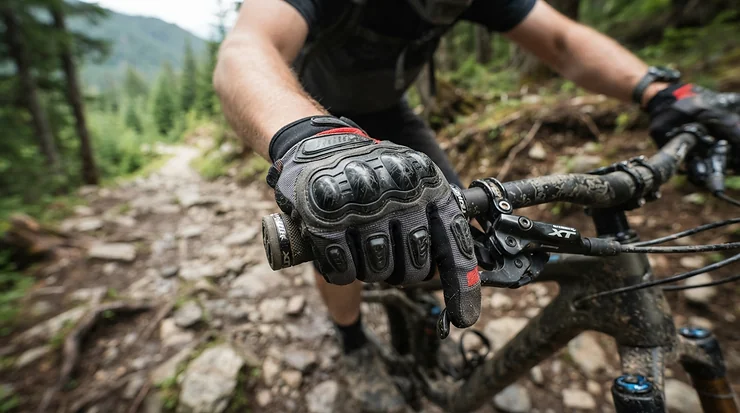
Enduro MTB gloves are full-finger mountain bike gloves built for fast, technical descents and long mixed-terrain days. They combine a thin, grippy palm for bar feel, a breathable stretch back and some form of knuckle protection, from simple rubber panels to D3O inserts. You can climb, race and fiddle with kit without stopping.
D3O, incidentally, is a British-developed rate-sensitive impact material that stays soft until struck, then stiffens to spread the force. It appears in several gloves below.
One honest note before we dive in. This guide is built from manufacturer specifications, published test reviews and retailer feedback, not from me pretending to have worn seven pairs down Innerleithen. Where reviews are thin, I say so. Where a spec matters, I explain what it does on the trail. We’ll cover the best enduro gloves under £30, the best trail gloves with knuckle protection, and how reinforced knuckles, grip texture and a race-ready fit change what you should buy.
Enduro MTB Gloves at a Glance: Quick Comparison Table
| Glove | Knuckle Protection | Typical Price Range | Best For |
|---|---|---|---|
| 100% Ridecamp | Minimal rubberised panel | £20-£25 | Riders who want maximum bar feel on a budget |
| Fox Ranger | None | £25-£30 | All-round trail and enduro use, no armour |
| Dakine Cross-X | Rubber/TPU and neoprene | £25-£38 | Budget riders wanting palm foam and knuckle guards |
| 100% Cognito D3O | D3O | £22-£37 | Real knuckle protection on a tight budget |
| Fox Defend D3O | D3O Ghost | £35-£45 | Tree-lined trails and light enduro racing |
| Endura MT500 D3O Glove II | D3O Ghost | £35-£45 | Riders who prioritise unpadded bar feel plus armour |
| Leatt MTB 3.0 Lite | ReaFlex gel, CE-tested | £40-£55 | Racers who want certified knuckle protection |
Looking at the table, the 100% Cognito D3O is the standout if you want proper armour without leaving the sub-£30 bracket, provided you catch it at a discount. Riders who hate padding will find the 100% Ridecamp and Fox Ranger cheaper and more direct. The Leatt MTB 3.0 Lite costs the most, but it’s the only glove here with a CE-tested knuckle claim, which matters if certification is on your checklist.
💬 Just one click — help others make better buying decisions too!😊
Top 7 Enduro MTB Gloves: Expert Analysis
Each glove below gets the same treatment: what the specs mean in practice, who it suits, what published reviewers and buyers report, and where it lands on value. Prices are ranges at the time of research (September 2026) and shift constantly, so check the current price before you buy.
1. 100% Ridecamp — lightest bar feel under £25
If you want to feel every lever click and grip twist, this is the starting point.
The 100% Ridecamp pairs a nylon/spandex back with a single-layer Clarino palm, silicone-printed palm and fingers, stretch finger gussets and touchscreen thread on the fingertips. In practice, a single-layer palm keeps the bar close and gives you precise brake modulation. The silicone print stops fingers sliding on wet levers. The gussets reduce bunching as you grip. The embossed slip-on cuff is shaped to accommodate a watch.
Be clear-eyed about protection, though. The rubberised knuckle graphic is a scuff guard, not armour. This is a glove for riders who graze rather than crash, or for anyone building a spare-pair collection. Testers at Bike Perfect praised its bike control, feedback and toughness for the price, while cautioning that sizing needs care. Several verified buyers on Biketart report a great fit. One found it tight to pull on, and another trimmed wrist stitching that dug in after an hour.
Pros:
- ✅ Excellent bar feel from a thin palm
- ✅ Touchscreen-compatible fingertips
- ✅ Comfortably inside a sub-£30 budget
Cons:
- ❌ No genuine impact protection at the knuckles
- ❌ Snug fit can be tricky to pull on
Around £20-£25 at UK retailers, with occasional dips below that. It’s strong value if you can live without armour.

2. Fox Ranger — the sensible do-it-all baseline
Think of this as the glove that lets you stop thinking about gloves.
The Fox Ranger uses a neoprene cuff with hook-and-loop adjustment, a single-ply palm and conductive thread at the forefinger. The adjustable strap lets you tune wrist fit, which matters more than people expect on a rough descent. A single-ply palm means direct feedback, much like the 100% Ridecamp. The trade-off is zero knuckle protection.
A road.cc review from September 2025 found the updated fit a vast improvement, praised the bar feel and traction, and confirmed the touchscreen thread works reliably. It called the glove a solid mid-season option that gets a bit sweaty in real heat. The same reviewer noted that printing on the glove had started to peel or wear. BikeRadar’s first-look coverage also flagged the competitive pricing, thin palms and grippy rubber on the first two fingers and thumb.
Pros:
- ✅ Adjustable wrist closure for a secure fit
- ✅ Reliable touchscreen thread on the forefinger
- ✅ Direct bar feel at a friendly price
Cons:
- ❌ No knuckle armour whatsoever
- ❌ Graphics may wear over time
Roughly £25-£30. It’s a safe bet as a first pair or a backup.
3. Dakine Cross-X — budget knuckle guards plus palm foam
This is the entry point if you want some armour and some palm cushioning without paying D3O money.
Dakine describes the current Dakine Cross-X as having updated TPU and neoprene knuckle protection, critical palm padding to dampen vibration, silicone grip reinforcements, touchscreen compatibility and a Velcro cuff. Earlier listings mention a 3mm foam palm pad. Knuckle plates like these deflect brush and glancing blows, but they aren’t the same as rate-sensitive D3O for a hard, direct hit. The palm foam calms trail buzz but puts a layer between you and the bar, which some riders love and others resent.
Reviews on mtbr split. Long-term fans praise durability and protection across multiple pairs, and one reviewer called it a light-duty downhill or heavy-duty trail glove. Critics report plastic parts detaching after about six months and odour issues. That mixed picture is why I’d treat this as a solid budget option, not a guaranteed long-termer.
Pros:
- ✅ Knuckle guards and palm padding at a modest price
- ✅ Touchscreen compatible with Velcro closure
- ✅ Odour-management technology in the fabric
Cons:
- ❌ Knuckle guards are less advanced than D3O
- ❌ Some reviewers report plastic parts detaching
Street prices range widely, roughly £25-£38 depending on colour and retailer. Good value when discounted into the high £20s.
4. 100% Cognito D3O — D3O knuckles at Ridecamp money (when discounted)
This is the one that makes “best enduro gloves under £30” a realistic search.
The 100% Cognito D3O brings D3O knuckles, a 4-way stretch back, mesh finger gussets, a Clarino palm with silicone print, touchscreen thread and an adjustable TPR wrist closure with hook-and-loop backing. The mesh gussets vent heat between the fingers, and the adjustable wrist closure helps lock in a race-ready fit. Treeline’s testers praised its knuckle and hand padding, comfort, ventilation and wrist closure, and noted it’s less versatile than lighter gloves. They also credited OutdoorGearLab with a top-pick award for protection.
It’s not flawless. One US retailer reviewer said the Velcro pad holding the wrist strap peeled off after about five months. On the Amazon UK listings I found, only a handful of ratings existed, so I lean on published tests here.
Pros:
- ✅ Genuine D3O knuckle protection
- ✅ Adjustable closure for a secure wrist fit
- ✅ Vented finger gussets for climbs
Cons:
- ❌ Bulkier feel than minimalist gloves
- ❌ Wrist strap durability questioned by one buyer
Recommended retail sits in the high £30s, but UK retailers commonly list it from the low-to-mid £20s. That’s outstanding value at that price.
5. Fox Defend D3O — slim D3O armour from a race-focused brand
Best for riders who want armour without the oven-glove feeling.
The Fox Defend D3O combines D3O Ghost knuckle inserts with stretch Cordura construction, a conductive Clarino palm and a low-profile hook-and-loop closure. Cordura on the back of the hand shrugs off brambles and scuffs better than thin mesh. Bike Perfect’s testers called it excellent for trail and light enduro use, with protection that doesn’t leave your hands feeling encumbered. They also noted a pad on the heel of each palm. In plain terms, you get D3O where knuckles meet trees, plus a little cushioning where the palm heel takes abuse.
Several UK retailer pages I checked carried no customer reviews yet, so the published test carries the weight here.
Pros:
- ✅ Slim D3O Ghost knuckle inserts
- ✅ Abrasion-resistant Cordura back of hand
- ✅ Touchscreen-friendly conductive palm
Cons:
- ❌ Costs more than the sub-£30 options
- ❌ Limited customer reviews at some retailers
Roughly £35-£45 (RRP is higher, with frequent discounts). Solid value if tree-lined trails are your home turf.

6. Endura MT500 D3O Glove II — zero-padding palm, Ghost knuckles
Perfect for riders who want armour on top and the bar underneath.
The Endura MT500 D3O Glove II is redesigned with D3O Ghost Knuckle inserts and a zero-padding palm, with silicone prints for wet grip, four-way stretch woven fabric and a guidance weight of around 57g. No palm padding means the bar feels immediate, while the thin D3O layer protects the knuckles without stiffening the fingers. Endura also backs it with a 90-day satisfaction guarantee.
Most published reviews cover the earlier MT500 D3O. The Loam Wolf found it protective without bulk, ideal in tightly tree-lined terrain, though fingers can still get hit below where the D3O ends. Off-road.cc rated the fit and build highly but found it a bit warm for summer. Endura’s own page shows no reviews yet for the II.
Pros:
- ✅ Unpadded palm for maximum bar feel
- ✅ Thin, flexible D3O Ghost protection
- ✅ 90-day satisfaction guarantee
Cons:
- ❌ Fingers below the D3O remain exposed
- ❌ Earlier version ran warm in summer
Previous-generation RRP sat in the mid-£40s, with typical street prices of £35-£45. Good value for riders who want feel and protection in one.
7. Leatt MTB 3.0 Lite — the only glove here with a CE-tested knuckle claim
This is the pick if certification matters as much as comfort.
The Leatt MTB 3.0 Lite features 3D-moulded ReaFlex impact gel knuckles, a MicronGrip palm, FormFit finger stitching, a vented four-way stretch upper, touchscreen compatibility and a lens/sweat wiper. Leatt says it’s CE tested as PPE under Regulation (EU) 2016/425, with knuckle impact protection to EN 13594:2015 using reduced requirements adapted for off-road use. That “reduced requirements” wording is worth reading: it’s a sensible off-road benchmark, not the full motorcycle standard.
MBR found it so light it’s almost like wearing nothing, with superb feedback through the MicronGrip palm. But the pull-on design, with no strap, proved tricky even after going up a size. One reviewer on a US retailer’s page, describing years of enduro racing, called the knuckle protection effective but not bulky, and the fabric breathable.
Pros:
- ✅ CE-tested knuckle impact protection
- ✅ Very light, with excellent bar feel
- ✅ Practical extras like a lens wiper
Cons:
- ❌ Pull-on design is hard to get on
- ❌ Highest price in this group
Expect roughly £40-£55, with sale colours dipping into the high £30s. It’s premium-priced but justified if you’ll use that certified protection.
✨ Ready to Upgrade Your Hands?
🔍 Take your trail confidence to the next level with these carefully compared gloves. Click any highlighted product name to check current pricing and availability. Your knuckles, your palms and your wallet will thank you!
How to Choose Enduro MTB Gloves
Choosing well is mostly about matching the glove to your riding damage profile. Here’s the process I’d follow.
- Decide how you crash. Brush scrapers and tree-huggers need different protection from riders who take big tumbles, so be honest about your terrain.
- Match knuckle protection to terrain. Rubber or TPU guards cope with brambles, while D3O or gel is better where hard branches are likely.
- Choose your palm philosophy. An unpadded palm gives feedback, while a foam palm reduces fatigue but adds isolation.
- Prioritise fit above everything. Measure your hand circumference and note whether you prefer a strap or slip-on cuff.
- Check ventilation. Enduro includes long climbs, so mesh gussets and thin backs matter more than they look.
- Set a realistic budget. Under £30 you can get solid basics, and sometimes D3O, but premium certification usually costs more.
- Look at the details. Touchscreen thread, sweat wipes and cuff length under your jersey sleeve make daily use nicer.

Best Enduro Gloves Under £30: What Your Money Actually Buys
A £30 ceiling sounds restrictive, but it covers a surprising amount of ground. In practice, the best enduro gloves under £30 come from four candidates: the 100% Ridecamp, the Fox Ranger, the Dakine Cross-X and, when discounted, the 100% Cognito D3O.
If your priority is armour, the 100% Cognito D3O is the clear winner in this bracket because it’s the only one with D3O. If you want direct feedback and simplicity, the 100% Ridecamp wins. The Fox Ranger sits between, offering an adjustable closure but no protection.
Where the money doesn’t stretch is usually the Leatt MTB 3.0 Lite, and often the Fox Defend D3O and Endura MT500 D3O Glove II, though seasonal discounts can shift things.
A quick bit of illustrative arithmetic: if a £25 pair lasts a 50-ride season, that’s 50p a ride. A £45 pair lasting 100 rides works out at 45p. Durability matters as much as the sticker, so a cheaper glove that fails early can cost more per ride. The best enduro gloves under £30 are the ones that survive your riding, not just your budget.
Best Trail Gloves With Knuckle Protection: Who Really Needs Them?
If you ride tight, tree-lined trails, the best trail gloves with knuckle protection are less a luxury than a sensible upgrade. A prospective study of hand and wrist injuries at Whistler and Squamish emergency departments concluded that mountain biking is a frequent source of a variety of upper limb trauma. BIKE Magazine’s coverage of that region’s data notes that fractures were the most common diagnosis among hand and wrist injuries, with metacarpal fractures particularly common.
That sounds alarming, and it should temper expectations. Gloves reduce grazes and knuckle bruises, but they don’t prevent broken bones. Treat them as one part of your kit, not a force field.
Within our seven, the best trail gloves with knuckle protection fall into three tiers:
- Rubber/TPU guards: Dakine Cross-X, the budget-friendly option
- Gel: Leatt MTB 3.0 Lite, with a CE-tested knuckle claim
- D3O: 100% Cognito D3O, Fox Defend D3O and Endura MT500 D3O Glove II
If you regularly clip trees or brush at speed, D3O or gel is the sensible step up. If your rides are open and flowing, the Fox Ranger or 100% Ridecamp might serve you better.
Grip Texture: Silicone Prints, Palms and Bar Feel
Grip texture is where enduro MTB gloves quietly earn their keep. Silicone printing stops fingers sliding on wet levers, and the palm material decides how much of the trail you feel.
BikeRadar’s testers note that padding is less common on trail, enduro and downhill gloves because it adds another layer of isolation from the trail below. That’s why most of our list favours thin palms. The exception is the Dakine Cross-X, which trades some feel for vibration damping.
| Glove | Palm Build | What It Means For Grip Texture and Feel |
|---|---|---|
| 100% Ridecamp | Single-layer Clarino, silicone print | Direct feedback, precise lever control |
| Fox Ranger | Single-ply palm, grippy print on fingers | Direct feel, good wet lever traction |
| Dakine Cross-X | Synthetic suede with foam padding | Damped, less tiring on long descents |
| 100% Cognito D3O | Clarino, silicone print | Direct feel with tech-thread fingertips |
| Fox Defend D3O | Conductive Clarino, heel pad | Direct feel with slight heel cushioning |
| Endura MT500 D3O Glove II | Zero-padding palm, silicone prints | Maximum bar feel, wet grip |
| Leatt MTB 3.0 Lite | MicronGrip palm | Direct feel, highly rated feedback |
Looking at the table, most of these gloves chase direct feedback, so grip texture is about print placement and palm material rather than cushioning. If your hands tire on long descents, the padded Dakine Cross-X is the outlier worth considering. If you want precision, the Endura MT500 D3O Glove II is the most extreme unpadded option here.
Race-Ready Fit: Sizing, Cuffs and Closures
A race-ready fit is one where the glove disappears. That means no bunching under your fingers on the lever, no wrist gap for a sleeve to catch, and no seam digging in after an hour.
Closures matter more than they look. Strap-based gloves like the Fox Ranger, 100% Cognito D3O and Fox Defend D3O let you tune wrist tension. Pull-on designs like the Leatt MTB 3.0 Lite are lighter and cleaner but harder to get on, especially with sweaty hands. The 100% Ridecamp uses an embossed slip-on cuff with a watch indent, which suits riders who wear a training watch.
Two practical fit tips:
- Measure properly. Wrap a tape measure across the widest part of your palm, excluding the thumb, and compare with the maker’s chart rather than assuming your usual size.
- Expect some stretch. Bike Perfect’s testers say they lean towards tighter gloves knowing they’ll stretch over time.
Forum reports suggest sizing up with Leatt gloves is common. Whatever you buy, a race-ready fit should let you grip a lever fully without fingers folding or bunching, and closing your fist should feel natural rather than fighting the glove.
Enduro MTB Gloves vs Road, Trail-Lite and Motocross Gloves
Why not just wear whatever’s in the drawer? Because different disciplines want different things.
| Glove Type | Palm | Knuckle Protection | Ventilation | Best For |
|---|---|---|---|---|
| Enduro MTB gloves (e.g. Fox Defend D3O) | Thin, grippy | D3O/gel/rubber | Good | Technical descents, racing |
| Road-style gel gloves | Thick padded | None | Excellent | Long road miles |
| Lightweight trail gloves (e.g. 100% Ridecamp) | Very thin | Minimal | Very good | Cross-country, mellow trails |
| Motocross gloves | Padded | Hard shell or padded | Moderate | Motorised off-road |
Looking at this, road gloves prioritise cushioning for long hours on tarmac, which usually blunts bar feel on rough trails. Motocross gloves offer armour but often trade away dexterity and airflow. Enduro MTB gloves try to sit in the middle, which is why gloves like the Fox Defend D3O and Leatt MTB 3.0 Lite feel purpose-built for the mixed climbs and descents of an enduro day.
Reinforced Knuckles and Safety Standards: What the Labels Mean
“Reinforced knuckles” can mean anything from a printed rubber logo to a moulded D3O insert, so read the small print.
Rubber or TPU panels resist scuffs and glancing blows. Gel inserts such as Leatt’s ReaFlex offer more cushioning. D3O relies on rate-sensitive behaviour, remaining flexible until impact then stiffening to spread force. Leatt’s claim that the Leatt MTB 3.0 Lite is CE tested with knuckle impact protection to EN 13594:2015 is the most formal standard among our seven. Leatt itself notes reduced requirements adapted for off-road use, so it’s a useful benchmark rather than a guarantee.
For context, the HSE explains that Regulation (EU) 2016/425, as incorporated into UK law, sets essential requirements for personal protective equipment placed on the market in Great Britain. Most new PPE must carry a UKCA or CE mark, a declaration of conformity and English instructions. Not every glove here claims PPE status, so check the product page for markings if certification matters to you.
Practically, reinforced knuckles help most on brush, trees and glancing strikes. They’re less effective against crush impacts or falls that load your wrist. Choose armour for the hazards you actually face.
Your First 30 Days: Break-In, Care and Maintenance
A new pair needs a little setup to perform well.
Week one: fit check. Grip your bars with the gloves on and close your fist. Any fabric bunching under the fingers or seam pressure at the wrist will only get worse on long rides. Swap sizes early if needed.
Break-in. Wear them on a few short rides before an event. Stretch fabrics loosen slightly, and hook-and-loop closures settle into place.
Washing. Dakine advises that its non-leather gloves can be machine washed, then gently pressed out and left to dry at room temperature, away from heaters or dryers. Check your care label, close any Velcro tabs before washing, and avoid radiators. Heat can damage adhesives and printed grip.
Common mistakes in the first month:
- Wearing a size too big, then wondering why levers feel vague
- Drying on a radiator, which can degrade printed grip and adhesives
- Ignoring early wear, such as a lifting Velcro pad like one reported on the 100% Cognito D3O
- Using one pair for everything, when rotating two lets each dry properly
A simple rotation of a primary pair and a cheap backup, perhaps a 100% Ridecamp, extends the life of both.
Which Gloves for Which Rider? Three Real-World Scenarios
Scenario 1: The weekend woodland rider on £25. You ride dry local singletrack once or twice a week and only scuff the odd branch. The 100% Ridecamp offers superb bar feel at this price, and the 100% Cognito D3O is worth grabbing if a discount pulls it into range. Neither will impress in a proper crash, but neither will drain your budget.
Scenario 2: The tree-lined trail regular on £40. You ride three times a week somewhere like Scotland’s Tweed Valley, and branches are constant company. The Fox Defend D3O gives slim D3O protection with a strap for a tuned fit. The Endura MT500 D3O Glove II is the better pick if you crave an unpadded palm.
Scenario 3: The UK enduro racer. You compete monthly, ride hard in changeable weather and care about certified protection. The Leatt MTB 3.0 Lite is the logical race-day glove, backed up by a spare 100% Ridecamp for warm-up laps and washing rotation. Fit your race-ready pair well ahead of event day, because pull-on gloves reveal their quirks over time.

FAQ
❓ Are D3O gloves worth it for mountain biking?
❓ Do enduro MTB gloves need palm padding?
❓ Can you wash mountain bike gloves in a washing machine?
❓ How long do enduro MTB gloves last?
❓ Is the Fox Ranger good for enduro?
Conclusion
The best enduro MTB gloves are the ones that match how you ride, not simply the ones with the most armour. For pure bar feel under £25, the 100% Ridecamp is hard to beat. The Fox Ranger is the easy all-rounder. If protection is your priority without stretching past £30, the 100% Cognito D3O is the bargain hunter’s choice when discounted, with the Dakine Cross-X as a more basic option.
Step up in price and you get slimmer D3O in the Fox Defend D3O and Endura MT500 D3O Glove II. At the top, the Leatt MTB 3.0 Lite brings CE-tested knuckle protection and superb feedback. Weigh reinforced knuckles against grip texture and a race-ready fit, because the perfect glove balances all three.
Prices move, so check current listings before you decide. Whichever you choose, fit it carefully, care for it properly and treat gloves as one part of a wider protection kit.
Recommended for You
- Full Finger Gloves For Cold Weather MTB: 7 Best Picks (2026)
- Full Finger MTB Gloves: 7 Best Picks For UK Trails (2026)
- Best MTB Gloves For Downhill: 7 Top Picks For 2026
Disclaimer: This article contains affiliate links. As an Amazon Associate, I earn from qualifying purchases. If you purchase products through these links, we may earn a small commission at no additional cost to you.
✨ Found this helpful? Share it with your friends! 💬🤗
