In This Article
Your hands hit the ground before any other part of you does. That’s not a scare tactic, it’s just physics — instinct sends your palms out first, every single time, whether you’re clipping a root at 3mph or overcooking a corner at 20. Full finger MTB gloves are the piece of kit standing between that reflex and a gravel rash that takes three weeks to stop weeping. Put simply, full finger MTB gloves are cycling gloves that cover every digit down to the fingertip, usually built with a padded or armoured back-of-hand, a grippy palm, and a snug wrist closure, designed specifically for the abrasion, impact and vibration mountain biking throws at your hands.

For UK riders, that’s not an occasional concern — it’s a weekly one. Between root-strewn Peak District descents, greasy Welsh singletrack, and the sort of drizzle that makes every trail a slip risk from October to April, the case for proper hand protection writes itself. The Highway Code’s guidance for cyclists covers helmets and visibility, but it’s silent on gloves — which leaves the decision, sensibly, in your hands (sorry).
This guide breaks down seven real, currently available full finger MTB gloves spanning budget, mid-range and premium price points, with honest analysis of knuckle protection, dexterity, brake lever feel and abrasion resistance — the four things that actually separate a good glove from an expensive mistake. No fluff, no invented five-star reviews, just spec comparison, aggregated review sentiment, and straight talk about what each pair is genuinely good at.
Quick Comparison Table: Best Full Finger MTB Gloves at a Glance
| Category | Pick | Price Range | Best For |
|---|---|---|---|
| Best Overall | Fox Racing Ranger | £25-£35 range | All-round trail riding |
| Best Budget | Giro DND | Under £25 | Dexterity on a tight budget |
| Best Knuckle Protection | Endura MT500 D3O | £35-£45 range | Aggressive enduro and downhill |
| Best Waterproof | Sealskinz Waterproof All Weather MTB | £35-£50 range | Wet, muddy British winters |
| Best Value Protection | INBIKE Knuckle Guard | Under £20 | Budget riders wanting armour |
Looking at this snapshot, the pattern that emerges is a straightforward trade-off: the thinner and cheaper a glove’s palm, the better its brake lever feel tends to be, while the gloves with genuine knuckle armour — Endura MT500 D3O and Leatt MTB 4.0 Lite — cost more precisely because that protection has to be engineered in without killing dexterity. If you’re commuting or riding smooth flow trails, the lighter end of this table probably suits you better than the armoured end.
💬 Already got a front-runner? Check current pricing before you decide — availability and colourways shift fast on popular sizes.
Top 7 Full Finger MTB Gloves: Expert Analysis
Coverage below spans budget essentials through to premium armoured options, with real specs, honest analysis, and aggregated review sentiment for each. Every product name stays bolded throughout so you can scan straight to the one you’re curious about.
1. Giro DND — best dexterity for the money
The clue is in the name: Down N Dirty, and that’s exactly the brief this glove nails. It skips a wrist closure entirely in favour of a cuffless, slip-on design, which sounds like a minor detail until you’re trying to get gloves on with cold fingers at a trailhead car park.
Specs-wise, the DND uses a three-panel synthetic suede palm (Giro calls it AX Suede) with reinforced tips on the index and middle fingers, plus a 2mm pad at the heel of the palm for ground-impact absorption. In practice, that thin palm construction is precisely why this glove is so often recommended for riders who prioritise bar feel and brake lever feel above all else — there’s barely any material between your fingertip and the lever.
Based on the spec sheet, this isn’t a glove built for crash protection so much as everyday comfort and control; it’s a trail glove, not an armoured one. Reviewers consistently note the DND’s durability relative to its price, with some riders reporting years of use across multiple wash cycles, though the tight, second-skin fit is best suited to average-to-long fingers rather than short or wide hands.
Pros:
- ✅ Wraparound fingertip reinforcement where gloves usually wear out first
- ✅ Slip-on cuff design speeds up getting geared up and off again
- ✅ Whisper-thin palm gives standout brake lever feel for the price
Cons:
- ❌ No dedicated knuckle padding for harder trail impacts
- ❌ Snug fit runs tight for wider or shorter-fingered hands
Priced under £25 in most sizes, the Giro DND remains one of the strongest value propositions in this entire round-up — you’re paying for fit and feel, not features, and for a lot of trail riders that’s exactly the right allocation of budget.
2. Fox Racing Ranger — best all-round trail glove
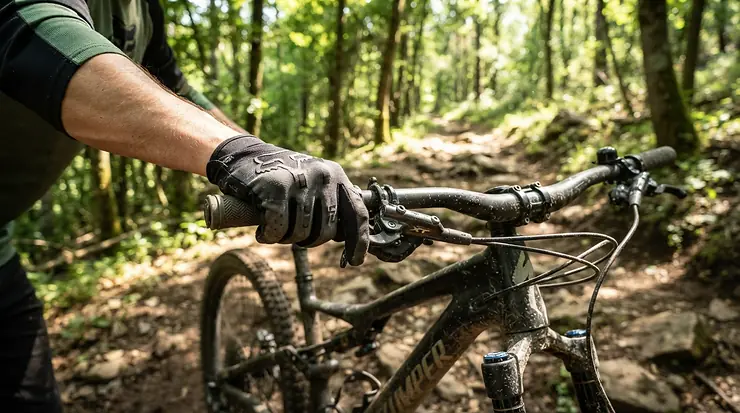
Fox’s Ranger line sits deliberately in the middle of the brand’s glove range — below the armoured Defend series, above the ultra-minimal Flexair — and that positioning shows in how it’s built. A four-way stretch backhand fabric moves through the full range of grip positions without bunching, and touchscreen-compatible fingertips mean you’re not stripping a glove off every time a text comes through mid-ride.
What most buyers overlook about a mid-range glove like this is that it’s engineered around ventilation and moisture-wicking as much as protection — the breathable, lightweight build keeps hands cooler on long climbs, which matters more than most riders expect until they’ve sweated through a heavier glove on a July slog uphill. The palm padding is present but modest, prioritising grip and lever feel over heavy cushioning.
Based on the spec comparison against the rest of this list, the Fox Racing Ranger reads as the glove for riders who want one pair that handles everything from the commute to the local trail centre without overthinking it. It doesn’t specialise, but it doesn’t disappoint anywhere either — a genuinely sensible default.
Pros:
- ✅ Touchscreen-compatible fingertips work reliably in damp conditions
- ✅ Four-way stretch fabric moves naturally through wide grip positions
- ✅ Wide colourway range makes matching kit painless
Cons:
- ❌ No dedicated knuckle armour, so it’s built for control, not crashes
- ❌ Thin palm padding means longer, rough descents can sting the hands
In the £25-£35 range on amazon.co.uk, the Fox Racing Ranger earns its “best overall” tag through sheer breadth of competence rather than any single standout feature.
3. INBIKE Knuckle Guard — best value protection pick
This is the glove that proves knuckle protection doesn’t have to cost premium-brand money. The backhand uses SCR and TPR rubber panels positioned specifically over the knuckle area, with coverage kept deliberately narrow so the surrounding fabric stays breathable rather than turning the whole back of the hand into a stiff plate.
On the palm side, a 5mm shock-absorbing pad handles vibration and impact from rock gardens, paired with non-slip silicone strips for wet-weather grip and touchscreen-compatible fingertips. What the spec sheet won’t tell you outright is that this level of armoured coverage at a sub-£20 price point is genuinely unusual — most brands reserve knuckle guards for their £30-plus tier.
Verified review data on lesser-known imports like this is inevitably thinner than for the big cycling brands, but the pattern among buyer feedback is consistent: solid protection and grip for the money, with sizing being the main point of friction — measuring your hand against the chart before ordering is worth the extra two minutes.
Pros:
- ✅ SCR and TPR knuckle guards rare at this price point
- ✅ 5mm palm padding takes the edge off rock-garden chatter
- ✅ Touchscreen fingertips and silicone grip strips included as standard
Cons:
- ❌ Sizing runs inconsistently between colourways — measure before ordering
- ❌ Denser knuckle panels mean less breathability once summer heat arrives
At under £20, the INBIKE Knuckle Guard is the glove to recommend to anyone who wants armour on a first-bike-park-trip budget without waiting for payday.
4. Sealskinz Waterproof All Weather MTB — best for wet British trails
Sealskinz has spent over 25 years building waterproof gear from a base in King’s Lynn, and this glove is arguably the most quintessentially British product on this entire list — designed for exactly the year-round drizzle-to-downpour conditions that define riding here. A polyurethane membrane mid-layer delivers genuine, tested waterproofing rather than a marketing claim, and the brand backs it with a lifetime waterproof guarantee.
Beyond the membrane, the palm uses a durable synthetic material blend with knuckle and finger protection pads on the backhand, plus silicone grippers on the two forefingers specifically for lever and shifter control when everything’s soaked. Reviewers consistently report that dexterity holds up surprisingly well for a fully waterproof glove — closer to a summer glove than the bulky, compromised feel typical of most winter-weather options, though a few note the backhand fit runs snug enough that trying before buying is sensible.
Here’s what the spec sheet doesn’t fully capture: waterproofing and dexterity are usually opposing goals in glove design, and the fact that Sealskinz manages both without the usual trade-off is precisely why this model shows up repeatedly in UK cycling media buyers’ guides.
Pros:
- ✅ Genuinely waterproof membrane backed by a lifetime guarantee
- ✅ Knuckle and finger protection pads without sacrificing bar feel
- ✅ Silicone grippers keep brake lever control secure when soaked
Cons:
- ❌ Backhand fit runs snug and can feel restrictive for broader hands
- ❌ Overkill warmth for anything but cold or wet UK rides
Sitting in the £35-£50 range, the Sealskinz Waterproof All Weather MTB glove earns its keep across a British winter alone.
5. Leatt MTB 4.0 Lite — best certified knuckle protection, minimal bulk
Leatt built its reputation on protective gear for downhill and enduro racing, and the MTB 4.0 Lite distils that into an ultra-thin package. Airflex impact gel covers the knuckles and extends down the third and fourth fingers — the digits statistically most likely to catch a low branch or a rock on a fast, tight trail — while a latticed, open construction keeps airflow moving through the padding rather than trapping heat against the skin.
Crucially, this isn’t a glove making unverifiable safety claims: it’s CE tested and certified as Personal Protective Equipment to EN 13594, the European standard specifically governing impact and abrasion protection for hand coverings. That’s a meaningful distinction most budget knuckle-guard gloves simply can’t make. The NanoGrip palm material, meanwhile, is engineered to be thin enough that bar feel and brake lever modulation barely register the glove is there.
Reviewers consistently praise the fit and comfort, though a recurring theme in aggregated feedback is that the lack of a Velcro wrist closure makes the glove genuinely fiddly to remove with sweaty or damp hands — a minor but repeated annoyance across independent reviews.
Pros:
- ✅ CE-certified Airflex knuckle protection tested to EN 13594
- ✅ NanoGrip palm delivers exceptional wet and dry lever feel
- ✅ Ultra-thin construction barely registers on the hand
Cons:
- ❌ No Velcro closure makes them a squeeze on and off with damp hands
- ❌ Leather-effect palm has been reported to mark lighter-coloured hands over time
At around £20-£30, the Leatt MTB 4.0 Lite undercuts what you’d expect to pay for certified impact protection — a genuinely strong mid-range pick.

6. Endura MT500 D3O — best premium knuckle armour
The Scottish-built MT500 range has a reputation for durability that borders on stubborn, and the D3O version adds what might be the most talked-about knuckle protection technology in mountain biking right now. D3O is a rate-sensitive material — soft and flexible during normal riding, but it stiffens instantly on impact to dissipate energy, sitting over the knuckles and extending down the outer edge of the little finger.
The palm uses a synthetic leather with a grippy silicone print across the palm, index and middle fingertips specifically to maintain lever control, and independent UK reviewers have repeatedly noted the MT500’s wrist cuff fit as the best of any glove in its class — it sits flat against the wrist rather than bunching under a jacket cuff. A detailed review of the D3O glove’s construction breaks down exactly how the material behaves under impact versus in normal use.
On the honest downside, reviewers have flagged that the D3O padding doesn’t extend quite far enough down the pinky and ring fingers for riders who grip in a more palms-down position — a real limitation rather than a nitpick, and worth knowing before you buy.
Pros:
- ✅ D3O Ghost Knuckle inserts harden only on impact, staying flexible otherwise
- ✅ Best-in-class wrist cuff fit of any glove in this lineup
- ✅ Four-way stretch ripstop back moves with the hand under load
Cons:
- ❌ Among the priciest options here — D3O technology adds real cost
- ❌ Protection doesn’t extend as far down the outer fingers as some riders need
At £35-£45, the Endura MT500 D3O is the glove for riders who’ve decided that knuckle protection is non-negotiable and are willing to pay for the best version of it.
7. 100% Brisker — best winter dexterity money can buy
Cold hands ruin rides faster than almost anything else, and the 100% Brisker has become something of a benchmark answer to that problem among UK reviewers — repeatedly cited across independent buyers’ guides as the standard other cold-weather gloves get measured against. It pairs an insulated softshell backhand with a medium-weight Clarino (vegan leather) palm, aiming to solve warmth without the usual bulk-versus-feel compromise.
That balance is the entire point: most winter gloves sacrifice dexterity for warmth, forcing you to fumble for brake levers with numb, oversized fingers. The Brisker’s design keeps the palm thin enough that lever modulation and shifting stay precise, while the insulated backhand blocks wind chill effectively in dry, sub-zero conditions. Conductive threads at the thumb and forefinger keep it touchscreen-compatible too.
Reviewers consistently rate this among the warmest gloves that don’t compromise control, though the honest caveat — repeated across multiple independent reviews — is that it isn’t fully waterproof; heavy, sustained rain will eventually soak through, even if the insulation keeps working while wet.
Pros:
- ✅ Warmth without the usual dexterity trade-off of winter gloves
- ✅ Clarino palm keeps brake lever modulation precise even when cold
- ✅ Durable enough to survive multiple winters of regular use
Cons:
- ❌ Not fully waterproof, so prolonged downpours will soak through
- ❌ Colour range for women’s sizing is more limited than men’s
In the £30-£40 range, the 100% Brisker is the clear pick for anyone who rides through a full British winter rather than hanging the bike up in October.
Full Finger MTB Gloves Compared: Specs, Price Ranges & Ratings
| Glove | Knuckle Protection | Palm Material | Price Range | Best For |
|---|---|---|---|---|
| Giro DND | None | Synthetic suede | Under £25 | Dexterity, everyday trail riding |
| Fox Racing Ranger | None | Lightweight synthetic | £25-£35 range | All-round versatility |
| INBIKE Knuckle Guard | SCR/TPR panels | Padded synthetic | Under £20 | Budget-conscious protection |
| Sealskinz Waterproof All Weather MTB | Light backhand pads | Synthetic + membrane | £35-£50 range | Wet, cold UK conditions |
| Leatt MTB 4.0 Lite | CE-certified Airflex gel | NanoGrip synthetic | £20-£30 range | Certified protection, minimal bulk |
| Endura MT500 D3O | D3O Ghost Knuckle | Synthetic leather | £35-£45 range | Aggressive enduro/downhill riding |
| 100% Brisker | None | Clarino (vegan leather) | £30-£40 range | Cold-weather dexterity |
Reading across this table, a clear split emerges between the three gloves offering genuine knuckle protection — INBIKE, Leatt, and Endura — and the four prioritising dexterity, weather resistance or all-round versatility instead. If you ride mellow flow trails or gravel, the second group will likely feel better on the bar; if you’re regularly threading tight, tree-lined singletrack or hitting bike park lines, the extra weight of armour on the first group buys real peace of mind.
✨ Take your glove drawer to the next level with a pair matched to how you actually ride! 🧤 Click through on any highlighted pick to check current pricing and availability before your next trail day.
Practical Usage Guide: Setting Up and Maintaining Your Full Finger MTB Gloves
Getting the most from any pair of full finger MTB gloves starts before the first ride. Fit them by measuring hand circumference just below the knuckles, then trying them in a full-grip position curled around an imaginary bar — excess material bunching in the palm is the single biggest cause of blisters and hot spots, and it’s far easier to catch in the shop or before you cut the tags off than three rides in.
A common first-30-days mistake is machine-washing gloves with knuckle protection on a hot cycle, which can degrade the bonding on foam or gel padding faster than the material itself would otherwise wear. Hand-washing in cool water, or a gentle 30-degree cycle inside a wash bag, extends the life of both the padding and the palm’s grip coating considerably. Letting gloves air dry away from direct heat — never on a radiator — prevents synthetic leather palms from cracking prematurely, which is one of the most common durability complaints across budget and mid-range gloves alike.
For gloves with a slip-on cuff design like the Giro DND, a light dusting of talc-free foot powder inside the cuff on humid days makes entry and exit noticeably easier. And for anything with silicone grip printing on the palm, avoid degreasing hand cleaners before rides — they can strip the tack that makes brake lever control feel secure in the first place.
Real-World Scenarios: Which Rider Are You?
The weekend trail centre regular. Riding twice a month on waymarked blue and red routes, budget around £25-£30, wants something that survives being left in a rucksack between rides. The Fox Racing Ranger or Giro DND cover this brief comfortably — neither demands babying, and both prioritise the all-day comfort this rider actually needs over armour they’ll rarely test.
The everyday commuter who also rides trails at weekends. Needs one glove that handles wet Tuesday commutes and Saturday singletrack without owning two pairs. The Sealskinz Waterproof All Weather MTB glove earns its higher price here through sheer versatility — genuine waterproofing for the commute, enough dexterity and protection for the trail, in a single purchase.
The enduro rider pushing technical, rooty terrain. Rides aggressively, has caught a knuckle on a tree before, and isn’t interested in gambling on it happening again. Between the Leatt MTB 4.0 Lite and Endura MT500 D3O, the choice comes down to budget and how much bulk you’re willing to accept: Leatt for CE-certified protection at a lower price, Endura if you want the more robust D3O coverage and don’t mind paying for it.
Buyer’s Decision Framework: Choosing the Right Full Finger MTB Gloves
If you ride mellow, flowing trails and value bar feel above all else, choose a minimalist glove like the Giro DND, because unnecessary padding only gets in the way of the brake lever feel you’re trying to protect. If you ride year-round through UK winters, choose a waterproof or insulated option — Sealskinz or 100% Brisker — because cold, wet hands lose grip strength and reaction time well before you notice it happening.
If you ride technical, tree-lined or rocky trails where a knuckle strike is a realistic possibility, choose a certified knuckle protection glove like the Leatt MTB 4.0 Lite, because CE-tested impact absorption is a meaningfully different thing from a glove that merely looks armoured. And if budget is the deciding factor but you still want genuine protection, the INBIKE Knuckle Guard delivers the closest thing to premium-tier armour coverage without the premium price tag.
How to Choose Full Finger MTB Gloves With Knuckle Protection
What is the best way to choose full finger MTB gloves? In short: match the glove’s protection level and material to your actual terrain and weather, then confirm fit through a full-grip test rather than sizing charts alone. Here’s the fuller breakdown:
- Assess your terrain first. Flowing, low-consequence trails need less armour than tight, technical singletrack — don’t buy protection you won’t use.
- Check for genuine certification, not just padding. A CE-tested rating to EN 13594 means the knuckle protection has been independently measured, not just marketed.
- Prioritise palm thickness based on brake feel. Thinner palms transmit more lever feedback; thicker padded palms trade some of that feel for comfort on rough, high-vibration trails.
- Match materials to your climate. Waterproof membranes and insulation matter far more in the UK than in drier climates — don’t underestimate how much a soaked glove degrades grip.
- Test the closure system. Velcro cuffs adjust more precisely; slip-on cuffs are faster but less forgiving of a loose or tight fit.
- Consider abrasion resistance for your riding style. Riders who crash occasionally on rocky or gravelly trails benefit from reinforced palm panels, since abrasion resistance is what actually prevents road rash in a slide.
- Don’t ignore touchscreen compatibility if you navigate by phone. It sounds trivial until you’re stripping a glove off mid-descent to check a GPX route.
Common Mistakes When Buying Full Finger MTB Gloves
The most common mistake is buying based on looks rather than terrain — a heavily armoured, downhill-style glove is genuinely uncomfortable for long climbs, and most UK trail centre riding simply doesn’t demand that level of protection. The second is ignoring hand shape: a glove cut for narrow, long fingers (like the Giro DND) will feel cramped and awkward on a wider hand, regardless of how good the reviews are.
A third mistake, particularly common with budget imports, is skipping the sizing chart entirely and guessing based on a previous glove from a different brand — sizing varies enough between manufacturers that this routinely results in returns. Fourth, plenty of riders overlook washing instructions and machine-wash gloves with knuckle padding on hot cycles, degrading the padding’s bonding well before the fabric itself wears out. Finally, riders often chase waterproofing they don’t need for eight months of the year, paying a premium for a feature that only earns its keep in winter.
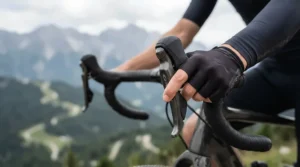
Full Finger MTB Gloves vs Half-Finger Gloves: Which Wins for Trail Riding?
| Factor | Full Finger MTB Gloves | Half-Finger Gloves |
|---|---|---|
| Knuckle & finger protection | Full coverage, fingertips included | Fingertips fully exposed |
| Abrasion resistance in a slide | High, across the whole hand | Fingers unprotected in a fall |
| Warmth in cold or wet conditions | Significantly better | Limited to no benefit |
| Ventilation in hot weather | Slightly reduced | Better airflow to fingertips |
| Best For | Trail, enduro, downhill, winter riding | Cross-country racing, hot climates |
The trade-off here is genuinely simple once you strip away the marketing: half-finger gloves ventilate better and let you feel the grips more directly with bare fingertips, but they leave exactly the part of your hand most likely to hit a branch, rock or the ground completely unprotected. For UK trail riding, where roots, low branches and unpredictable weather are the norm rather than the exception, full finger MTB gloves win on protection and warmth in the vast majority of real-world scenarios, and the ventilation gap has narrowed considerably as mesh backhand materials have improved.
What to Expect: Real-World Performance on the Trail
On paper, palm thickness and padding density are just numbers, but they translate directly into how a trail actually feels under your hands. A thin-palmed glove like the Giro DND transmits far more information from the grips — you’ll feel small changes in traction and terrain that a thicker glove muffles, which experienced riders often value more than raw protection on familiar trails.
Knuckle protection, meanwhile, is largely invisible until the one moment it matters. Reviewers of gel and D3O-based systems consistently describe barely noticing the padding during normal riding, only becoming aware of it during a genuine impact — which is exactly how good protective design is supposed to work. Waterproof gloves like the Sealskinz Waterproof All Weather MTB behave differently again: the membrane construction means slightly reduced tactile feedback on the palm, a trade-off most riders find entirely worth it the first time a British winter downpour hits mid-ride.
Long-Term Cost, Durability & Abrasion Resistance
| Tier | Typical Price Range | Expected Lifespan | Cost-Per-Ride Reasoning |
|---|---|---|---|
| Budget (Giro DND, INBIKE) | Under £25 | 1-2 seasons of regular use | Lower upfront cost, faster palm wear |
| Mid-range (Fox Ranger, Leatt 4.0 Lite) | £20-£35 range | 2-3 seasons | Balanced durability and protection |
| Premium (Endura MT500 D3O, Sealskinz, Brisker) | £35-£50 range | 3+ seasons, heavier build | Higher upfront cost, better long-term value |
The maths on abrasion resistance is straightforward once you frame it as cost-per-ride rather than sticker price: a £45 glove that lasts four seasons of weekly riding works out considerably cheaper than replacing an £18 pair every single season because the palm has worn through. Reinforced panels, like the synthetic leather used on the Endura MT500 D3O, are specifically engineered to resist the repeated micro-abrasion of gripping bars and the occasional hands-first slide, which is where cheaper synthetic materials tend to degrade fastest.
Safety, Regulations & Compliance Guide
Unlike helmets, full finger MTB gloves aren’t a legal requirement under UK cycling law, and the Highway Code’s cycling rules don’t mandate them specifically — but that doesn’t mean protection standards don’t exist. The relevant benchmark, EN 13594, is a European standard governing impact and abrasion protection for hand coverings, originally developed for motorcyclists but increasingly adopted by mountain bike glove manufacturers who want to make verifiable protection claims rather than marketing ones.
Gloves certified to this standard, like the Leatt MTB 4.0 Lite, have been independently tested for knuckle impact absorption, seam strength and tear resistance — a meaningfully higher bar than a glove simply advertising “knuckle protection” without third-party verification. It’s also worth noting the physiological side of hand protection: independent physiotherapy guidance on cycling-related hand and wrist pain points to padded gloves as one practical way to reduce pressure on the ulnar nerve during longer rides, alongside proper bike fit and hand position changes. For a broader view of how different protection technologies compare across the market, independent UK buyers’ guides are a useful second opinion before committing to any single pair.

Frequently Asked Questions
❓ Are full finger MTB gloves better than fingerless gloves for mountain biking?
❓ What is the best budget full finger MTB glove in the UK?
❓ Do MTB gloves with knuckle protection reduce dexterity?
❓ How long do full finger MTB gloves typically last?
❓ Can full finger MTB gloves be used for road cycling too?
Conclusion
Choosing between these seven gloves ultimately comes down to matching protection level to the trails you actually ride, not the trails you occasionally imagine riding. The Giro DND and Fox Racing Ranger cover everyday trail centre riding brilliantly without overcomplicating things, while the INBIKE Knuckle Guard proves budget and protection aren’t mutually exclusive. For UK weather specifically, the Sealskinz Waterproof All Weather MTB and 100% Brisker solve genuinely different problems — one wet, one cold — and both are worth owning if your riding season doesn’t stop in October.
For riders who’ve decided knuckle protection is worth paying for, the Leatt MTB 4.0 Lite offers certified protection at a surprisingly accessible price, while the Endura MT500 D3O sits at the top of this list for anyone riding aggressive, technical terrain where a hand injury is a real possibility rather than a hypothetical one. Whichever direction you go, the underlying advice holds: try the full-grip test before buying, check the current price and available sizes on amazon.co.uk, and remember that the glove that protects your hands is only as good as how consistently you actually wear it.
✨ Ready to gear up?
Browse today’s prices on the pair that matched your riding style best — your hands will thank you on the next rocky descent! 🧤🚵
Recommended for You
- Best MTB Gloves For Downhill: 7 Top Picks For 2026
- Best Budget MTB Gloves: 7 Top Picks For UK Trails (2026)
- Finger Road Gloves With Gel Padding: 7 Proven Picks (2026)
Disclaimer: This article contains affiliate links. As an Amazon Associate, I earn from qualifying purchases. If you purchase products through these links, we may earn a small commission at no additional cost to you.
✨ Found this helpful? Share it with your riding mates! 💬🤗
