In This Article
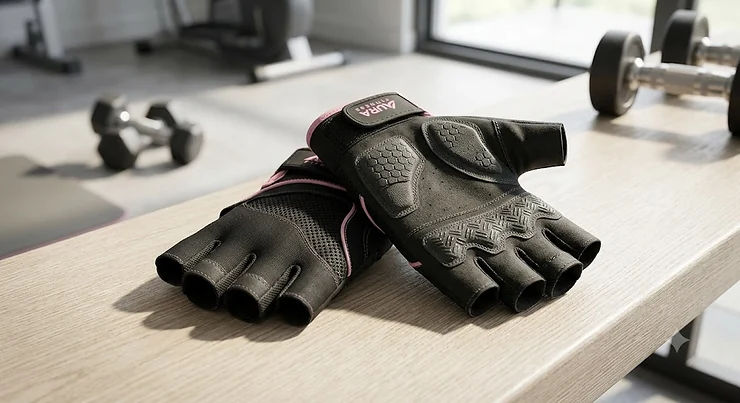
Your hands do more heavy lifting than any other body part in the gym, and yet they’re usually the last thing anyone thinks about kitting out properly. If you’ve ever racked a barbell and caught sight of a fresh split callus, or shaken out a wrist that’s gone wobbly halfway through a set of deadlifts, you already know why half finger gym gloves for women exist. They’re not a fashion statement (though some of them are genuinely quite sharp) — they’re a barrier between soft skin and knurled steel, and a bit of scaffolding for a wrist joint that wasn’t really built to hold 40kg overhead. Grip strength itself is a specific, trainable part of hand strength, and it’s central to nearly every lift you’ll do with a barbell or dumbbell in hand.
This guide walks through seven real, currently available options — from no-frills budget picks to gloves with proper integrated wrist wraps — and gets honest about what actually matters versus what’s just marketing gloss. We’ve dug into verified specs, aggregated review sentiment, and the sort of practical detail Amazon listings tend to skip over, like how “breathable” mesh performs after month three, or why a longer wrist strap isn’t automatically a better one. Whether you’re chasing extra palm padding, proper wrist stability, or just something that won’t turn your hands into a sweaty mess by rep twelve, there’s a pair here that fits. Let’s get into it.
Quick Comparison Table
| Product | Best For | Wrist Support | Price Range |
|---|---|---|---|
| Harbinger Women’s Pro Gloves | Beginners wanting light support | Minimal (elastic cuff) | £15-£20 |
| RDX Weight Lifting Gloves Women | Grip-focused training | Hook-and-loop strap | £12-£18 |
| Harbinger Pro Wristwrap 2.0 Women’s | Serious wrist stability | Integrated wrap | £20-£28 |
| Gold’s Gym Women’s Tacky Gloves | Tight budgets, tacky grip | Basic strap | £8-£14 |
| RDX Long Wrist Support Gloves | Heavy deadlifts/presses | 50cm long wrap | £18-£24 |
| Nike Women’s Fundamental Training Gloves II | Everyday gym-goers, styling | Elastic wrist band | £16-£22 |
| ihuan Breathable Women’s Gloves | Hot gyms, cardio-lifting hybrid | Adjustable strap | £10-£16 |
Looking at the spread above, there’s a clear pattern: the cheaper end of the market (Gold’s Gym Women’s Tacky Gloves, ihuan Breathable Women’s Gloves) leans on simple elastic or strap closures rather than proper wrap systems, while anything north of £18 tends to bring a longer, more adjustable wrist component into play. That’s not a hard rule, though — the RDX Weight Lifting Gloves Women sit in the mid-teens and still manage a genuinely useful hook-and-loop strap. Your choice really comes down to how much wrist involvement your training style demands, which is exactly what we’ll unpack through the rest of this piece.
💬 Already got a favourite from the table? Scroll down to compare it against the full field before you commit.
Top 7 Half Finger Gym Gloves for Women: Expert Analysis
1. Harbinger Women’s Pro Gloves — lightweight leather palm for moderate lifting
The Harbinger Women’s Pro Gloves trade bulk for flexibility, and honestly, that’s the whole appeal. Where some lifting gloves feel like you’re wearing oven mitts, this one uses a vented, cushioned leather palm that lets your hand close around a barbell almost the way it would bare-handed. The women’s-specific cut means a narrower palm width and shorter finger length than the unisex version, which matters more than it sounds — a glove that’s too wide bunches up in your palm exactly where you need the padding to sit flat.
Specs-wise, you’re looking at a two-piece perforated leather palm, an elasticated wrist cuff (not a full wrap), and finger pull-tabs for quick removal. Based on the spec comparison with heavier wristwrap models later in this list, the trade-off here is obvious: less wrist rigidity in exchange for a glove that barely registers on your hand during lighter accessory work. Reviewers consistently report that sizing runs slightly generous, so it’s worth going down half a size from your usual measurement. A recurring theme in aggregated feedback is that the leather softens nicely after a few sessions but starts thinning around the base of the thumb after six-plus months of regular deadlifting, which tracks with the lighter-duty construction.
Pros:
- ✅ Genuinely thin and flexible for a leather-palmed glove
- ✅ Women’s-specific sizing avoids the bunching problem
- ✅ Quick pull-tabs make on/off fast between sets
Cons:
- ❌ Minimal wrist support, not built for max-effort lifts
- ❌ Thumb-base leather wears faster under heavy volume
Priced around £15-£20, the Harbinger Women’s Pro Gloves land as solid value for anyone doing moderate-weight, higher-rep training rather than 1-rep-max chasing.
2. RDX Weight Lifting Gloves Women — rubberised gel grip for slippery hands
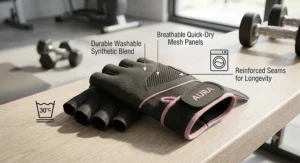
If sweaty palms have ever cost you a rep, the RDX Weight Lifting Gloves Women are built specifically around that problem. Instead of relying purely on fabric texture, RDX layers a rubberised, gel-padded grip across the palm, which genuinely changes how the bar feels in your hand — more “stuck to it,” less “sliding around.”
The 3mm gel cushioning sits under an ergonomic construction that lets fingers curl naturally rather than fighting a stiff seam, and the inner sweat-wicking lining is doing real work here, not just a marketing line. What most buyers overlook about this model is that the short finger length isn’t a cost-cutting measure — it’s deliberate, reducing bulk so your grip stays compact on smaller equipment like dumbbell handles. Aggregated review sentiment points to strong praise for grip security during pull-ups and rowing movements specifically, alongside a recurring gripe that the hook-and-loop wrist strap, while functional, isn’t rated for genuinely heavy pressing work.
Pros:
- ✅ Rubberised gel grip noticeably reduces bar slippage
- ✅ Sweat-wicking lining keeps palms drier longer
- ✅ Compact fit suits smaller equipment and pull-up bars
Cons:
- ❌ Wrist strap is basic, not a true stability wrap
- ❌ Rubber grip can feel warm during long, humid sessions
At roughly £12-£18, this sits firmly in “smart mid-range buy” territory, particularly for anyone whose main complaint with gloves has always been grip rather than wrist pain.
3. Harbinger Pro Wristwrap 2.0 Women’s — serious wrist stability for heavier lifts
This is where the range steps up properly. The Harbinger Pro Wristwrap 2.0 Women’s gloves bring an actual integrated wrist wrap into the picture, not just an elastic cuff — meaning the support is stitched directly into the glove and tightens independently of the palm fit. For anyone who’s felt their wrist buckle slightly on a heavy overhead press or a stacked leg-press machine, this is the category of glove designed to prevent exactly that.
Built from 4-way stretch Lycra with a genuine leather palm, the design balances flexibility with the rigidity needed at the wrist joint — a combination that’s genuinely hard to get right, and one Harbinger has iterated on since its 1988 founding as a wrist-stabilising glove brand for skateboarders-turned-lifters. Here’s what to weigh: the wrap does add a small amount of bulk compared to the standard Pro Gloves above, so if your training is mostly bodyweight or light cardio-strength hybrid work, you may find it more support than you need. Reviewers consistently note the wrap holds its tension well over time rather than going slack, which is the single biggest failure point on cheaper wrist-wrap gloves.
Pros:
- ✅ Integrated wrist wrap gives real joint stability
- ✅ Leather palm holds up well to repeated heavy use
- ✅ Wrap tension doesn’t loosen quickly with wear
Cons:
- ❌ Bulkier fit than lighter Harbinger models
- ❌ Premium price for occasional or light gym-goers
Expect to pay in the £20-£28 range — a reasonable ask for what functions almost like a wrist wrap and glove combined into one purchase.
4. Gold’s Gym Women’s Tacky Half-Finger Gloves — budget pick with a tacky, no-slip palm
Not every lifter needs — or wants — to spend £20+ on gloves, and the Gold’s Gym Women’s Tacky Half-Finger Gloves exist for exactly that reality. The standout feature is right there in the name: a tacky-textured palm surface designed to grip the bar through friction rather than heavy padding, which keeps the glove thin, light, and genuinely cheap.
On paper this means less cushioning against callus formation than the leather or gel-padded options above, so if you’re already prone to hand soreness, this probably isn’t your first pick. What it does well is grip security for lighter and moderate loads — the tacky coating works, and it works from the first wear, without needing a break-in period. Based on aggregated customer sentiment, this model is consistently described as good value for beginners still working out whether gloves suit their training style at all, with the honest caveat that durability tops out somewhere around four to six months of regular use before the tacky coating starts to smooth off.
Pros:
- ✅ Genuinely low price point for a half-finger design
- ✅ Tacky grip works immediately, no break-in needed
- ✅ Thin profile suits smaller hands well
Cons:
- ❌ Limited palm padding versus leather/gel alternatives
- ❌ Tacky coating wears down faster than premium materials
At around £8-£14, this is the “try gloves without committing” option — and a genuinely sensible one at that price point.
5. RDX Long Wrist Support Gloves — 50cm strap for heavy deadlifts and presses
For lifters chasing serious wrist alignment during max-effort work, the RDX Long Wrist Support Gloves bring a 50cm wrist strap into play — considerably longer than the standard 20-25cm wraps found on most half-finger gloves, including several others on this list. That extra length allows multiple wraps around the wrist, giving a genuinely adjustable, custom-tightness fit rather than a fixed loop.
The anti-slip padded palm sits underneath this, providing full palm coverage rather than the shorter, gel-dot style padding seen on the RDX Women’s model above. What most buyers overlook is that a longer strap isn’t just “more support” in the abstract — it distributes pressure across a wider band of the wrist rather than concentrating it in one narrow strip, which matters if you’ve ever found shorter wraps digging in uncomfortably during heavy pulls. Reviewers consistently flag the strap length as the standout feature, with a smaller but real subset noting that the extra fabric takes a bit of practice to wrap quickly between sets.
Pros:
- ✅ 50cm strap allows genuinely adjustable wrist tightness
- ✅ Full palm padding suited to heavy pressing and pulling
- ✅ Pressure spreads across a wider wrist band
Cons:
- ❌ Longer strap takes practice to wrap efficiently
- ❌ Overkill for light accessory or cardio work
Priced around £18-£24, this is the pick for anyone whose training genuinely revolves around near-maximal lifts rather than general gym maintenance.
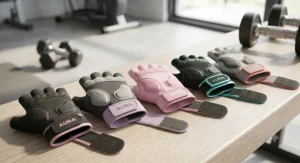
6. Nike Women’s Fundamental Training Gloves II — everyday comfort from a trusted name
Sometimes you just want a glove that looks good, fits well, and does its job without fuss — and the Nike Women’s Fundamental Training Gloves II deliver exactly that brief. Nike’s women’s training range focuses on high-density foam padding placed specifically at pressure points on the palm, paired with breathable mesh across the back of the hand and a pull-tab design for fast on/off between exercises.
The foam padding here is thinner than the leather or gel options further up this list, which on paper means less protection during genuinely heavy barbell work — but it also means the glove flexes more naturally through cardio-strength circuits, cycling, or general functional training where you’re moving your hands through varied grips constantly. Here’s what to weigh: this is a glove built for versatility across a training week rather than maximal specialisation in any one lifting style, and reviewers consistently describe it as comfortable for extended sessions without the “sweaty hand” complaint that plagues cheaper synthetic-palm gloves.
Pros:
- ✅ Comfortable across varied training styles, not just lifting
- ✅ Breathable mesh genuinely reduces hand sweat
- ✅ Recognisable brand with consistent sizing
Cons:
- ❌ Less palm protection for genuinely heavy lifting
- ❌ Wrist support is elastic-band level, not a wrap
Sitting around £16-£22, it’s a fair price for a brand-name glove aimed at everyday gym-goers rather than competitive lifters.
7. ihuan Breathable Women’s Gloves — lightweight pick for hot gyms and mixed training
Rounding out the list, the ihuan Breathable Women’s Gloves lean hard into ventilation, and if you’ve ever trained in a gym with questionable air conditioning in August, you’ll understand why that’s worth its own dedicated slot. The open-back, mesh-heavy construction prioritises airflow, paired with an enhanced palm protection zone and an adjustable wrist strap that sits somewhere between the minimal elastic cuffs and the full wraps seen elsewhere in this list.
Based on the spec comparison with the RDX and Harbinger options above, this glove clearly isn’t chasing maximal wrist rigidity or heavy-duty palm padding — it’s optimised for comfort across rowing, pull-ups, and general fitness training rather than one-rep-max attempts. What the spec sheet won’t tell you, but user reports suggest, is that the breathability genuinely holds up in warm conditions where other half-finger gloves start to feel clammy by the second exercise. The trade-off, unsurprisingly, is a shorter functional lifespan under very heavy, repeated barbell contact compared with the leather-palmed options.
Pros:
- ✅ Excellent breathability for warm gyms or humid sessions
- ✅ Comfortable for mixed cardio and strength training
- ✅ Adjustable strap offers a middle-ground wrist fit
Cons:
- ❌ Less durable under sustained heavy barbell contact
- ❌ Palm padding thinner than dedicated lifting gloves
At around £10-£16, it’s a smart pick for anyone whose training week is more varied than pure powerlifting-style sessions.
Top 7 Products: Full Comparison
| Product | Palm Material | Wrist Support Type | Best For | Price Range |
|---|---|---|---|---|
| Harbinger Women’s Pro Gloves | Vented leather | Elastic cuff | Moderate, higher-rep lifting | £15-£20 |
| RDX Weight Lifting Gloves Women | Rubberised gel | Hook-and-loop strap | Grip-focused, sweaty hands | £12-£18 |
| Harbinger Pro Wristwrap 2.0 Women’s | Leather + Lycra | Integrated wrap | Heavy, max-effort lifts | £20-£28 |
| Gold’s Gym Women’s Tacky Gloves | Tacky synthetic | Basic strap | Beginners, tight budgets | £8-£14 |
| RDX Long Wrist Support Gloves | Padded synthetic | 50cm long wrap | Deadlifts, heavy presses | £18-£24 |
| Nike Women’s Fundamental Training Gloves II | Foam-padded synthetic | Elastic band | Mixed, everyday training | £16-£22 |
| ihuan Breathable Women’s Gloves | Mesh + padded zone | Adjustable strap | Hot gyms, mixed training | £10-£16 |
The table makes the trade-off pattern obvious once you line all seven up side by side: wrist support scales roughly with price, but palm material and breathability don’t follow the same curve at all — the budget-friendly ihuan Breathable Women’s Gloves actually out-ventilate several pricier options. If your main frustration has always been sweaty, slipping hands rather than wrist instability, you can genuinely save money by prioritising palm material over strap length.
Half Finger vs Full Finger Gloves for Weightlifting
This is one of the most common forks in the road for anyone shopping half finger weightlifting gloves for the first time, and it’s worth settling properly rather than guessing. Half-finger gloves, sometimes called fingerless gloves, cover the palm and part of the fingers while leaving fingertips exposed; as Wikipedia’s overview of weightlifting gloves explains, these gloves reduce friction from the bar to provide extra grip strength and lower injury risk, with half-fingered designs being the most common type, offering wrist support and reduced calluses, though breathability can suffer depending on material. Full-finger gloves, by contrast, wrap the entire hand for maximum protection but sacrifice tactile feedback.
| Factor | Half Finger | Full Finger |
|---|---|---|
| Grip feel | Excellent — fingertips feel the bar | Reduced — fabric between skin and bar |
| Callus protection | Good on the palm, none on fingertips | Full coverage, best for finger calluses |
| Breathability | Generally better | Can trap heat and sweat |
| Best For | Barbell/dumbbell lifting, pull-ups | Rowing machines, outdoor training |
Direct fingertip contact matters more than most first-time buyers expect — it’s the difference between feeling exactly how the bar sits in your hand and grip-guessing through a layer of fabric, which becomes genuinely important once you’re loading a bar past bodyweight. Full-finger gloves earn their keep in colder training environments or on equipment with rough, high-friction handles like some rowing machines, where finger-specific protection outweighs the feel trade-off. For the vast majority of women doing dumbbell, barbell, and kettlebell work in a standard gym, half-finger remains the more practical default.
Practical Usage Guide: Getting the Most From Your Gloves
Buying the right pair is only half the job — how you use and maintain them determines whether you’re still wearing the same gloves in eighteen months or replacing them every six. Start by sizing correctly: measure around your palm (excluding the thumb) at its widest point and match it against the specific brand’s chart, since Harbinger, RDX, and Nike all size slightly differently despite using similar S/M/L labels. A glove that’s even half a size too big will bunch fabric into your palm exactly where the bar sits, undoing the whole point of padding.
In the first thirty days, resist the urge to keep wrist wraps as tight as possible on every single lift — reserve maximum tension for genuinely heavy sets, and loosen off for warm-ups and lighter accessory work, both for comfort and to extend the wrap’s elasticity long-term. Air-dry gloves after every session rather than leaving them balled up in a gym bag; trapped moisture is the single biggest cause of premature leather cracking and synthetic material breakdown. For leather-palmed models specifically, an occasional wipe with a damp cloth (never fully soaking them) keeps the material supple rather than stiff and prone to cracking at the finger joints. A common early mistake is judging fit after one wear — leather in particular softens and moulds to your hand shape over the first five to ten sessions, so give a new pair a fair trial before deciding they don’t fit right.
✨ Ready to Upgrade Your Grip?
🔍 Take your training to the next level with a pair matched to how you actually lift. Click through to check current pricing and availability on any of the gloves above — the right fit could be the difference between a personal best and a cut-short session.
Real-World Scenarios: Which Glove Fits Your Training Style
The busy beginner. Say you’re three months into a gym membership, training four times a week around a full-time job, mostly using machines and dumbbells in the £10-15kg range. Comfort and quick on/off matter more than maximal wrist rigidity here — the Gold’s Gym Women’s Tacky Gloves or ihuan Breathable Women’s Gloves suit this profile well, keeping cost low while you figure out whether gloves are even a long-term habit.
The strength-focused intermediate. If you’re training three to four times weekly with a structured programme involving heavier barbell work — think progressive deadlifts, overhead presses, and weighted pull-ups — grip security and some wrist stability start to matter genuinely. The RDX Weight Lifting Gloves Women or Harbinger Women’s Pro Gloves hit that middle ground of support without the bulk of a full wrist wrap.
The dedicated lifter chasing PBs. For anyone regularly attempting near-maximal lifts, training five-plus times a week, and genuinely feeling wrist strain under load, the extra investment in the Harbinger Pro Wristwrap 2.0 Women’s or RDX Long Wrist Support Gloves pays for itself in injury prevention alone. This is where wrist support add-ons stop being a nice-to-have and start being closer to essential kit.
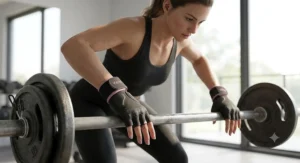
How to Choose Half Finger Gym Gloves for Women
Choosing the right pair comes down to matching glove features to your actual training pattern rather than chasing whichever option has the flashiest listing photos. Here’s a practical framework:
- Assess your primary lift types. Heavy barbell and deadlift-focused training benefits from wrist wrap gloves like the Harbinger Pro Wristwrap 2.0 Women’s; general dumbbell and machine work rarely needs that level of support.
- Check your sweat factor honestly. If slipping grip is your biggest complaint, prioritise gel or rubberised palms like the RDX Weight Lifting Gloves Women over breathability-first designs.
- Measure your palm properly. Wrap a tape measure around your palm’s widest point (excluding thumb) and check it against the specific brand’s size chart before buying.
- Decide your budget ceiling honestly. Entry-level options like Gold’s Gym Women’s Tacky Gloves are genuinely fine for moderate training; don’t overspend on wrist support you won’t use.
- Consider your gym’s climate. Warm, poorly ventilated gyms favour breathable picks like the ihuan Breathable Women’s Gloves over heavier leather designs.
- Factor in training variety. If your week mixes cardio, machines, and free weights, versatile options like the Nike Women’s Fundamental Training Gloves II avoid the need for multiple glove types.
- Plan for replacement cycles. Budget gloves may need replacing every four to six months under regular use; premium leather options can last considerably longer with proper care.
Half Finger Gym Gloves With Wrist Support: What the Add-Ons Actually Do
Wrist support add-ons get thrown around as a blanket selling point, but the mechanics differ significantly between models, and understanding that difference is worth more than any spec sheet alone. An elastic cuff, like the one on the Harbinger Women’s Pro Gloves, provides a snug fit that stops the glove from riding down mid-set — but it does very little to actually stabilise the wrist joint itself under load. A hook-and-loop strap, as seen on the RDX Weight Lifting Gloves Women, adds a genuine adjustable tightening element, giving some resistance against excessive wrist extension during pressing movements.
The step up is an integrated wrap, like the Harbinger Pro Wristwrap 2.0 Women’s or the extended 50cm version on the RDX Long Wrist Support Gloves. These function closer to how a dedicated wrist wrap works when worn separately — they physically limit the range of hyperextension the wrist can move through under heavy load, which is genuinely protective during overhead pressing, heavy front-rack positions, or maximal-effort bench work. What most buyers overlook is that tighter isn’t automatically better here: over-tightening a wrist wrap can restrict blood flow and cause numbness within a set, which does nothing for performance and everything for discomfort. The right tension supports the joint without cutting off circulation — a balance that takes a session or two to dial in properly.
Women’s Palm Padding: What Actually Matters
Palm padding is arguably the single most misunderstood spec on any lifting glove listing, largely because “padded” gets used as a catch-all term covering wildly different materials and thicknesses. Thin foam padding, as used on the Nike Women’s Fundamental Training Gloves II, cushions against moderate friction and light callus formation but offers limited protection against sustained heavy-load pressure points. Gel padding, like the 3mm layer on the RDX Weight Lifting Gloves Women, sits in the middle — genuinely effective cushioning that stays flexible rather than compressing flat over time, though it can trap warmth in hot conditions.
Leather palms, whether the vented style on the Harbinger Women’s Pro Gloves or the reinforced version on the Wristwrap 2.0, offer the most durable long-term protection and tend to mould to your hand shape with use, improving comfort the more you wear them. On paper this means leather should always win — but here’s what to weigh: leather adds break-in time, costs more, and requires actual care (air-drying, occasional conditioning) that synthetic or tacky-coated alternatives simply don’t demand. For women with smaller hands specifically, padding placement matters as much as padding type; generic unisex gloves often place cushioning zones sized for larger palms, leaving smaller hands with padding that sits awkwardly rather than under the actual pressure points. This is precisely why women’s-specific sizing, rather than a “small” unisex option, tends to fit meaningfully better.
Glove Weight and Flexibility: The Trade-Off Nobody Explains Clearly
Every gram of padding and every centimetre of wrist wrap you add to a glove comes at the cost of natural hand movement, and that trade-off gets glossed over in most product descriptions. Lighter, more flexible gloves — the ihuan Breathable Women’s Gloves and Gold’s Gym Women’s Tacky Gloves among them — let your fingers curl and your palm flex almost as naturally as bare-handed lifting, which matters enormously for movements requiring fine grip adjustment, like kettlebell swings or varied-grip pull-ups.
Heavier, more structured gloves like the Harbinger Pro Wristwrap 2.0 Women’s sacrifice some of that natural movement in exchange for stability and protection — a reasonable trade when you’re moving maximal loads, but genuinely counterproductive for high-rep, dynamic movements where hand mobility drives performance. Reviewers consistently note that gloves feeling “stiff at first” from heavier-duty models tend to loosen up after several sessions as materials break in, so an initial impression of restrictiveness isn’t always the final word. The practical takeaway: match glove weight to movement type rather than buying the heaviest-duty option available on the assumption that more support is always better — for dynamic, varied training, flexibility usually wins out over maximal rigidity.
Common Mistakes When Buying Half Finger Gym Gloves for Women
The most frequent error is buying based on unisex “small” sizing rather than genuinely women’s-specific cuts, which — as covered above — tend to misplace padding relative to smaller palms. A close second is prioritising wrist wrap length over actual need; buying the RDX Long Wrist Support Gloves for general dumbbell circuits is genuinely overkill, adding bulk and cost without matching benefit. Skipping proper sizing measurement in favour of guessing based on regular glove size is another consistent trap, since lifting glove sizing rarely matches everyday glove or clothing sizing conventions.
On the flip side, some buyers go too cheap for their training intensity — a beginner glove like the Gold’s Gym Women’s Tacky Gloves genuinely isn’t built for someone already deadlifting 1.5x bodyweight, and expecting budget tacky-grip construction to hold up under that load leads to disappointing durability complaints that are really a mismatch issue rather than a product flaw. Finally, neglecting basic care — leaving gloves damp and balled up post-workout — shortens the lifespan of even premium leather models considerably faster than normal wear alone would.
Long-Term Cost & Maintenance
Thinking purely in upfront price misses the real cost-per-wear picture. A £10 pair of tacky-coated gloves lasting four to six months under regular use works out to roughly £1.70-£2.50 per month of ownership, assuming three to four sessions weekly. A £24 pair of well-maintained leather wristwrap gloves lasting eighteen months to two years under similar use drops that figure to under £1.20 per month — cheaper over time despite the higher entry cost, provided the care routine covered earlier is actually followed.
Maintenance costs are genuinely minimal either way — proper air-drying costs nothing, and an occasional leather conditioner application (if you go that route) runs a few pounds every few months at most. The real “cost” that catches people out is replacement frequency driven by mismatched buying decisions covered in the mistakes section above: buying support you don’t need adds unnecessary upfront spend, while buying durability you’ll outgrow within a few months of progressive training means paying twice in a single year. Matching the glove to your actual training trajectory, not just your current level, tends to be the more genuinely cost-effective long-term call.
Safety, Sizing and Fit Guide
Getting the fit right isn’t just a comfort issue — it’s a safety one. A glove that’s too loose can bunch or shift mid-lift, creating an unstable grip at exactly the wrong moment during a heavy set. Too tight, and circulation restriction can cause numbness or reduced grip feedback, both of which increase drop risk rather than preventing it. The safest approach is measuring your palm circumference directly rather than relying on general clothing size, and checking that against the specific brand’s published size chart, since — as noted earlier — sizing varies meaningfully between Harbinger, RDX, Nike, and smaller brands.
Strength training itself carries genuine, well-documented health benefits worth the effort of getting your kit right: the NHS’s physical activity guidelines for adults aged 19 to 64 recommend doing strengthening activities that work all the major muscle groups on at least two days a week, alongside 150 minutes of moderate intensity activity weekly. Gloves are a small piece of that picture, but a properly fitted pair removes one more barrier — hand pain and grip anxiety — that can otherwise get in the way of maintaining that consistency. If you’re new to strength training entirely, it’s worth reading through the NHS’s guide to improving strength and flexibility, which explains that a genuine strength exercise is any activity that makes your muscles work harder than usual, to the point where a short rest is needed before continuing, before worrying too much about equipment specifics.
Problem → Solution: Fixing Common Hand and Grip Issues
Problem: Hands slip on the bar despite wearing gloves. This usually points to worn-out palm material rather than a fundamental glove failure — check for smoothed-out tacky coating or compressed gel padding, both signs it’s replacement time. A gel-palmed option like the RDX Weight Lifting Gloves Women tends to hold grip longer than tacky-coating alternatives.
Problem: Wrist discomfort persists even with wrist-support gloves. This often means the wrap is either too loose to actually stabilise the joint or too tight and restricting circulation — neither helps. Re-check the tension guidance covered in the wrist support section above, and consider sizing up if the wrap consistently feels constrictive rather than supportive.
Problem: Gloves feel unbearably hot within one session. Leather and heavily padded gloves trap more heat than mesh-back alternatives. Switching to a breathability-focused pick like the ihuan Breathable Women’s Gloves solves this directly, particularly for anyone training in a warm gym or during summer months.
Problem: Gloves have gone stiff and cracked at the finger joints. This is almost always a moisture and drying issue — sweat trapped in a balled-up glove breaks down leather and synthetic fibres far faster than normal wear. Reintroducing proper air-drying after every session (covered in the usage guide above) prevents this going forward, though existing cracking usually means it’s time for a replacement pair.
Problem: Uncertainty over which glove suits a specific lift. Cross-reference the scenario section above against your actual weekly training split rather than guessing — the right glove genuinely differs between a deadlift-heavy programme and a circuit-style dumbbell routine.
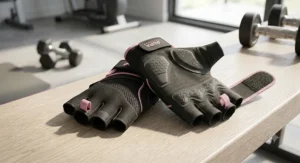
FAQ
❓ Do half finger gym gloves for women actually improve grip?
❓ What size should I buy if I'm between sizes?
❓ Are wrist support add-ons necessary for light lifting?
❓ How long do half finger weightlifting gloves typically last?
❓ Can I wear half finger gloves for pull-ups and rowing too?
Conclusion
There’s no single “best” pair here — that’s genuinely the honest takeaway after comparing all seven side by side. The right half finger gym gloves for women depend on what you’re actually lifting, how your hands sweat, and whether wrist stability is a nice-to-have or a real necessity for your training style. Budget-conscious beginners get real value from the Gold’s Gym Women’s Tacky Gloves or ihuan Breathable Women’s Gloves; grip-focused lifters should look hard at the RDX Weight Lifting Gloves Women; and anyone chasing serious strength numbers will get the most genuine benefit from the wrist-wrap-equipped Harbinger Pro Wristwrap 2.0 Women’s or RDX Long Wrist Support Gloves.
Whichever direction you go, the core principle from this whole guide holds: match the glove’s features to your actual training pattern rather than the flashiest spec sheet. A glove that’s overbuilt for your needs is just extra bulk and cost; one that’s underbuilt leaves you exposed exactly where you need protection most. Take the comparison tables above, check them against your own weekly training split, and go with the pair that genuinely fits — not just your hand, but your training life.
✨ Found the right pair for your training? Check current pricing on Amazon UK before you head back to the gym. 💬🤗
Recommended for You
- Half Finger Gym Gloves 2026: 7 Best Picks for Grip & Comfort
- Half Finger Gloves Under £10: 7 Best Picks for 2026
- Full Finger Gym Gloves for Women: 7 Best Picks
Disclaimer: This article contains affiliate links. As an Amazon Associate, I earn from qualifying purchases. If you purchase products through these links, we may earn a small commission at no additional cost to you.
✨ Found this helpful? Share it with your friends! 💬🤗
