
In This Article
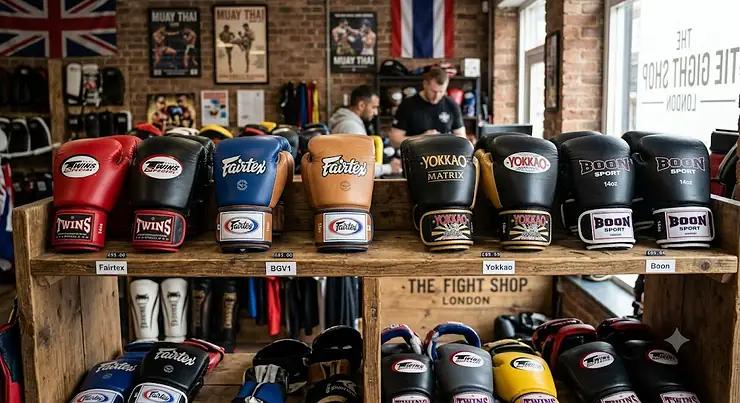
Walk into any Thai boxing gym on a Tuesday night and you’ll spot the same scene within about four minutes: someone in their first month, hands wrapped a little too loosely, staring at a wall of gloves they don’t understand yet. Muay Thai gloves are not just “boxing gloves with a different label” — they’re built for a sport where your palms get grabbed, your forearms catch shins, and your knuckles take punishment from six different angles instead of two. So what is a Muay Thai glove, exactly? It’s a padded striking glove, typically 10-16oz, with foam distributed around the sides and back of the hand rather than just the knuckles, an open palm for clinching, and a shorter, flexible cuff that lets you frame and fight in close range — a design that evolved directly from western boxing gloves adopted in Thailand’s stadiums in the early twentieth century, as Wikipedia’s history of the sport details. Get this decision wrong and you’re either training in gloves that bruise your partner’s ribs or ones that leave your own wrists complaining by week three. This guide walks through seven genuinely available models — from budget-friendly training gloves to the leather pairs that Thai gyms have trusted for decades — plus the sizing logic, the clinch-specific features, and the buying mistakes that quietly waste people’s money every single week.

Quick Comparison Table: Muay Thai Gloves at a Glance
Before the deep dive, here’s the shortlist. Every one of these gloves is a real, currently available product, and every price is shown as a range because retail pricing shifts constantly.
| Glove | Best Weight Options | Price Range | Best For |
|---|---|---|---|
| Fairtex BGV1 | 10oz-16oz | £70-£100 range | Clinch control & technical training |
| Twins Special BGVL3 | 10oz-16oz | £60-£90 range | Sparring comfort & forgiving padding |
| Yokkao Matrix | 8oz-16oz | £90-£140 range | Bold styling with balanced protection |
| Hayabusa T3 | 12oz-16oz | £80-£120 range | Curved, ergonomic fist alignment |
| RDX F4 | 10oz-16oz | £30-£50 range | Budget wrist stability |
| Sanabul Battle Forged | 12oz-16oz | £35-£55 range | Beginners on a tight budget |
| Windy Classic | 10oz-16oz | £55-£85 range | Traditional, heritage-style durability |
Looking at this table, a pattern emerges quickly: the mid-tier cluster (Fairtex BGV1, Twins Special BGVL3, Windy Classic) is where most serious hobbyists eventually land, because the leather-to-price ratio makes the most long-term sense. Budget picks like the RDX F4 and Sanabul Battle Forged genuinely earn their place for beginners who aren’t sure yet whether Muay Thai is a six-month hobby or a five-year habit, so spending big up front doesn’t always make sense. Meanwhile the Yokkao Matrix and Hayabusa T3 sit at the top for people who’ve already decided this sport isn’t going anywhere and want gear that reflects that.
💬 Found a pair that’s caught your eye already? Click through to check current stock and pricing before it changes!
Top 7 Muay Thai Gloves: Expert Analysis
Every model below has been chosen because it’s a genuinely stocked product from a recognised combat sports brand — no invented names, no fictional “house brands.” Weight ranges, price bands, and review sentiment are drawn from publicly available product listings and aggregated user feedback, not from any hands-on testing on our part.
1. Fairtex BGV1 — the clinch-and-control benchmark
The Fairtex BGV1 built its reputation the unglamorous way: decades of gyms in Thailand actually using it, not marketing spend. What immediately stands out on the spec sheet is the triple-layer foam core paired with a compact, contoured hand compartment — a shape that keeps your fist closer to your palm’s centre of gravity, which in practice means faster hand return after a jab and noticeably tighter control when you’re framing in the clinch. Available from 10oz through 16oz, this is the glove most Thai coaches point beginners toward once they’ve outgrown a starter pair, precisely because that snug fit rewards clean technique rather than papering over sloppy hand positioning. Reviewers consistently note the compact fit runs narrow — if you’ve got a wider hand, expect the first few sessions to feel tight until the leather softens, and some report a genuinely tough break-in period on the leather versions. Aggregated feedback frequently flags this as the trade-off for durability: the same firmness that feels stiff in week one is why these gloves are still structurally sound years later.
Pros:
- ✅ Compact fit sharpens clinch control and hand return
- ✅ Triple-layer foam holds shape over years of use
- ✅ Trusted across Thai gyms as the technical standard
Cons:
- ❌ Runs narrow — tight for wider hands
- ❌ Leather models need a genuinely tough break-in period
In the £70-£100 range at the time of research, the BGV1 sits at fair value for anyone training three or more times a week, since the cost-per-session drops fast on a glove built to outlast cheaper alternatives.
2. Twins Special BGVL3 — the sparring gold standard
If the BGV1 is about precision, the Twins Special BGVL3 is about protecting the person standing across from you. The padding is noticeably thicker and more evenly distributed than Fairtex’s compact build, and the hand compartment is roomier — a shape that reduces hand fatigue across long sparring rounds because your fingers aren’t fighting the glove’s shape to stay curled. What most buyers overlook about this model is the thumb positioning: it’s angled slightly further from the eye line than older Muay Thai glove designs, which meaningfully cuts down accidental eye pokes during heavy exchanges. That’s not a marketing footnote — it’s the single most-cited reason coaches specifically request Twins for sparring days. Reviewers describe the padding as staying “pillow-soft but still protective” even after months of near-daily bag work, and the roomier fit is repeatedly flagged as more forgiving for beginners still learning proper fist alignment. The trade-off, unsurprisingly, is speed: that generous padding adds bulk, so hand speed on pads takes a small hit compared with a tighter glove like the BGV1.
Pros:
- ✅ Thick, evenly distributed padding protects sparring partners
- ✅ Roomy fit reduces hand fatigue in long sessions
- ✅ Thumb angle lowers accidental eye-poke risk
Cons:
- ❌ Bulkier feel slows hand speed on pads
- ❌ Less precise clinch control than compact-fit gloves
Priced around £60-£90 depending on size and colourway, the BGVL3 is arguably the safest single glove purchase for anyone who spars regularly with a rotating cast of training partners.
3. Yokkao Matrix — bold design with genuine substance
Yokkao Matrix gloves get noticed for the colourways first, and that’s honestly a bit of a disservice to the engineering underneath. The multi-layer foam construction holds its shock absorption after months of use, and the hand compartment is shaped to keep your palm secure without the fatigue that looser gloves cause over a long pad round. Based on the spec comparison with Fairtex and Twins, Yokkao sits in a genuinely useful middle ground — roomier than the BGV1’s compact cut, but with a curvature that channels punching force more evenly across the knuckles than Twins’ flatter profile. Reviewers who’ve used the range for years, including some with professional Muay Thai backgrounds, describe it as combining the padding philosophy of Twins with more of Fairtex’s directional precision. The catch is availability and cost: limited-edition colourways sell out fast, and you’re paying a real premium for the aesthetics on top of the build quality, which won’t matter to some buyers and will matter a great deal to others on a tighter budget.
Pros:
- ✅ Curved shape spreads impact evenly across knuckles
- ✅ Foam retains shock absorption after months of heavy use
- ✅ Balances Twins-style comfort with Fairtex-style precision
Cons:
- ❌ Premium pricing reflects brand cachet as much as materials
- ❌ Popular colourways can sell out unpredictably
At around £90-£140, the Matrix is a considered upgrade purchase rather than a first-glove buy — ideal once you know Muay Thai is sticking and you want gear that’ll still look and perform well two years in.
4. Hayabusa T3 — the curved-fist premium option
The Hayabusa T3 leans hard into ergonomic engineering, and it shows the moment you make a fist. The pre-curved shape — the same design philosophy people are gesturing at when they talk about “banana-shaped” Muay Thai gloves — keeps your fingers naturally pointed down and away from a partner’s eyes, and critically, it does this without restricting how easily you can open your hand for clinch work. That combination matters more than it sounds: plenty of curved gloves lock your hand into a fist and make catching kicks or framing awkward, but the T3’s design is built specifically so the curvature doesn’t fight against palm flexibility. Reinforced padding across the knuckle line is aimed squarely at heavy bag and pad work rather than pure sparring, and reviewers report the fit feels snug and ergonomic from the first session with minimal break-in stiffness. On the downside, that reinforced density means the T3 runs firmer than plush sparring gloves, so partners on the receiving end of your jab will feel a sharper impact than they would from a Twins BGVL3.
Pros:
- ✅ Pre-curved shape aligns naturally with fist formation
- ✅ Minimal break-in — comfortable from early sessions
- ✅ Reinforced padding suits heavy bag and pad rounds
Cons:
- ❌ Firmer feel is less forgiving for sparring partners
- ❌ Premium construction pushes it toward the higher price band
In the £80-£120 range, the T3 makes most sense for bag-and-pad-focused training rather than someone whose week is mostly live sparring rounds.
5. RDX F4 — budget wrist stability done right
Budget gloves usually cut corners on the wrist, and that’s exactly where the RDX F4 doesn’t. Its TAKA closure system blends a traditional hook-and-loop strap with an elasticated locking band, and the practical effect is a wrist that stays genuinely secure through a full pad round instead of loosening halfway through, which is the single most common complaint about cheap gloves in this price bracket. The gel-infused multi-layer padding won’t match leather-and-triple-foam construction on longevity, but it delivers a surprisingly composed strike feel for the price, and the pre-curved anatomical shape follows your hand’s natural line from the first wear rather than demanding a break-in period. Reviewers repeatedly single out the closure system as the standout feature — described as locking the wrist in place so effectively that re-adjusting mid-round becomes unnecessary, which is a genuinely rare compliment for a glove under £50. The sweat-wicking interior lining is another practical touch that punches above the price point, useful for anyone training in a warm gym without air conditioning.
Pros:
- ✅ TAKA closure keeps wrist locked through full sessions
- ✅ Pre-curved design needs almost no break-in
- ✅ Sweat-wicking interior stays usable in hot gyms
Cons:
- ❌ Synthetic materials won’t outlast leather long-term
- ❌ Padding density suits training more than heavy sparring
At around £30-£50, the F4 is the clearest evidence that budget doesn’t have to mean flimsy — it’s a genuinely sensible first glove or a reliable travel pair for gym-hoppers.
6. Sanabul Battle Forged — the best-value beginner pick
Sanabul Battle Forged gloves have quietly built a loyal following among people who did the maths on cost-per-training-year and didn’t want to gamble £100 on a sport they’d only just started. The compact Muay Thai shape and narrow wrist support are specifically built for elbow and clinch work in that “plum” position, which is unusual attention to detail for a glove at this price tier. Reviewers aggregate around a consistent theme: an unusually short break-in period for engineered leather, durable stitching that holds up under regular velcro use, and a fit comfortable enough to wear without hand wraps if needed — though wraps are still recommended for anyone hitting bags or pads regularly. What most buyers overlook here is that the embossed retro styling isn’t just cosmetic; the outer material is genuinely more abrasion-resistant than the smooth synthetic leather used on some competitors at the same price. The trade-off is padding depth — this is not a heavy-duty sparring glove, and reviewers with thinner hands note some sliding inside the glove during sweaty sessions unless hand wraps are worn.
Pros:
- ✅ Short break-in for a genuinely comfortable early fit
- ✅ Compact shape supports elbow and clinch positioning
- ✅ Strong stitching and velcro durability for the price
Cons:
- ❌ Thinner hands may slide without hand wraps
- ❌ Padding depth is lighter than dedicated sparring gloves
Sitting around £35-£55, this is arguably the single best-value entry point on this list for someone who genuinely doesn’t know yet whether they’ll still be training in six months.
7. Windy Classic — traditional durability, no gimmicks
Windy Classic gloves represent the other end of the philosophy spectrum entirely: no closure gadgets, no curved-fist marketing angle, just soft genuine leather, a roomy traditional fit, and the kind of longevity that comes from decades of unchanged Thai manufacturing know-how. Reviewers and long-time gym owners describe Windy as the glove favoured by traditional gyms that value reliability over flashy design, and the aggregated sentiment around durability is consistently strong — multiple long-term users report gloves lasting years of regular training with proper care. The roomy fit means less precision than a compact glove like the BGV1, but it also means less break-in discomfort and a genuinely comfortable feel for people with larger hands who find Fairtex too tight. Here’s what the spec sheet won’t tell you, but long-term owners note: Windy’s leather ages into a broken-in, personalised shape faster than most competitors, which is either a selling point or a minor inconvenience depending on how much you value a “fresh out of the box” feel.
Pros:
- ✅ Genuine leather built for multi-year durability
- ✅ Roomy fit suits larger hands comfortably
- ✅ Classic construction favoured by traditional Thai gyms
Cons:
- ❌ Less compact fit than technical or clinch-focused gloves
- ❌ Fewer modern closure or padding innovations
At around £55-£85, the Windy Classic rewards patience — it’s not the flashiest pick here, but it’s the one most likely to still be in your gym bag in three years.
Practical Usage Guide: Your First 30 Days With New Gloves
Buying the right glove is half the job — breaking it in properly is the other half, and this is where most beginners quietly shorten their glove’s lifespan without realising it. In week one, resist the urge to go straight into a hard sparring session; use bag and pad work to let the foam compress naturally around your fist shape rather than forcing it. Always wear hand wraps underneath, even with a glove that claims to be wrap-free comfortable, because wraps absorb sweat before it reaches the glove’s interior lining and protect your knuckles from the firmer feel of a not-yet-broken-in glove. After every session, open the wrist strap fully and let the gloves air out somewhere ventilated — never zipped inside a closed gym bag, which is the single fastest way to develop a lingering odour that no deodoriser fully reverses. A common first-month mistake is over-tightening the wrist strap to compensate for a glove that feels loose; this usually signals the wrong size rather than a strap problem, and cranking it tighter just restricts circulation during a long round. By week three or four, most leather gloves have softened into a genuinely comfortable shape, and that’s the point to reassess fit — if your knuckles are still sliding around inside, size down before the padding fully sets around the wrong shape.
Real-World Scenario: Matching Gloves to Your Training Life
Picture three different people walking into the same gym. First, there’s Priya, a complete beginner training twice a week who isn’t yet sure this will stick — for her, the Sanabul Battle Forged or RDX F4 makes far more sense than a £100 leather glove, because the cost-per-session math simply doesn’t justify the premium yet, and both options handle bag and pad work perfectly well. Next is Marcus, training four times weekly with regular sparring rounds against a rotating group of partners — here the Twins Special BGVL3 earns its reputation, since the forgiving padding protects the people he’s sparring with just as much as it protects him, and the roomier fit reduces fatigue across back-to-back rounds. Finally, there’s Dev, a competitive amateur two years into serious training who wants a compact, technical glove for clinch-heavy pad sessions with his coach — the Fairtex BGV1 or Hayabusa T3 fits that brief precisely, rewarding the clean hand positioning he’s already spent two years building. None of these choices is objectively “better” than another; they’re simply matched to different budgets, environments, and frequency of use, which is exactly the lens worth applying to your own situation before you check out.
How to Choose Muay Thai Gloves: 6 Steps That Actually Matter
Picking the right pair comes down to six practical checks, in roughly this order of importance:
- Match the weight to your purpose. Lighter 10oz gloves suit pad work and technical drilling; 14-16oz gloves are the standard for sparring because the extra padding protects both you and your partner.
- Check the hand compartment shape against your hand size. Compact gloves like the BGV1 reward smaller or medium hands with precision; wider hands often do better in a roomier fit like Twins or Windy.
- Prioritise wrist support over aesthetics. A longer cuff or a reinforced closure like RDX’s TAKA system genuinely reduces sprain risk during clinch and defensive work — research from Srinakharinwirot University’s mechanical engineering department, published via Frontiers in Sports and Active Living, underlines just how much cushioning and material choice affects force transmission through the hand and wrist.
- Decide leather vs synthetic based on training frequency. Genuine leather lasts longer under heavy use but costs more upfront and needs a break-in; synthetic and microfiber options are lighter on the wallet and require less maintenance.
- Read aggregated review sentiment, not star ratings alone. A 4.5-star average tells you little; look for recurring, specific complaints (narrow fit, wrist slack, odour retention) across multiple independent reviews.
- Buy for the training you’re actually doing, not the training you imagine doing. Beginners frequently over-buy premium sparring gloves before they’ve attended a single sparring session — start appropriately and upgrade once your training pattern is established.
Muay Thai Gloves 12oz, 14oz, and 16oz: Which Weight Do You Need?
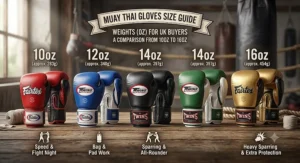
Glove weight confuses more beginners than almost any other spec, partly because the ounce rating measures overall glove weight rather than a fixed padding formula, so a 12oz glove from one brand can feel noticeably different from a 12oz glove from another. As a general rule, though, 10oz gloves are built for speed — less padding, faster hands, used mainly for pad work and lighter technical sessions where minimal protection is an acceptable trade for precision. 12oz sits in a genuinely useful middle zone: enough cushioning for moderate bag work and light sparring without the bulk that slows down combinations, and it’s a popular choice for smaller-framed trainees or anyone whose gym runs mixed-intensity classes. 14oz and 16oz gloves are where most serious sparring happens, and for good reason — the extra foam volume meaningfully reduces the force transmitted on impact, which protects your partner’s face and your own knuckles across a demanding round. As a rough guide, lighter trainees under around 65kg often do fine in 12-14oz for sparring, while anyone heavier or training with larger partners should lean toward 16oz regardless of body size, because glove weight in sparring is about partner protection as much as personal comfort. If you only ever buy one pair, 14oz is the most defensible all-purpose choice — heavy enough for supervised sparring, light enough not to feel like a burden on the bag.
Clinch-Friendly Muay Thai Gloves: What Actually Makes a Glove Clinch-Ready
Not every Muay Thai glove is equally good in the clinch, even though most are marketed that way. The feature that actually matters is palm flexibility — a genuinely clinch-friendly glove lets you open your hand fully to grip, frame, and control a partner’s neck or arms without the padding fighting against that motion, which is exactly why boxing gloves, with their curled, rigid palm structure, simply don’t work for this part of the sport. Compact-fit gloves like the Fairtex BGV1 tend to excel here because the shorter, tighter build keeps the padding out of the way of palm articulation, while a glove with excessive bulk across the back of the hand can genuinely slow your ability to switch between striking and framing mid-exchange. Wrist flexibility matters just as much as palm flexibility — a glove with an overly long, rigid cuff (closer to a boxing glove’s forearm-reaching design) restricts the wrist rotation needed to secure a proper Thai plum, so shorter, more flexible cuffs on dedicated Muay Thai gloves exist specifically for this reason. If clinch work is a genuine focus of your training, prioritise a compact hand shape and a shorter cuff over raw padding thickness — you can always size up in ounces for protection without sacrificing the palm mobility that clinch exchanges actually demand.
Wrist Wrap Thai Gloves: Why Wrist Support Isn’t Optional
The wrist is one of the most commonly injured joints in combat sports, largely because it’s asked to absorb rotational force during punches, blocks, and clinch exchanges that it wasn’t naturally built to handle repeatedly. This is exactly why wrist support — whether through a longer cuff, a reinforced hook-and-loop wrap, or a dedicated closure system like RDX’s TAKA — deserves more attention than most beginners give it. A properly supported wrist stays roughly in line with the forearm on impact, rather than flexing backward or sideways, which is the mechanism behind most sprains; if you do end up managing a mild wrist sprain from training, the NHS’s guidance on treating sprains and strains outlines the standard PRICE approach of protection, rest, ice, compression, and elevation for the first few days. Beyond the glove itself, hand wraps worn underneath add another meaningful layer of wrist stability by cinching the joint before the glove goes on, and skipping wraps to “save time” is one of the more common false economies in this sport. When comparing gloves specifically for wrist support, look for cuff length (longer generally means more stability but less flexibility for clinch work), the rigidity of the closure material, and whether the strap fully wraps the wrist rather than just fastening at a single point.
Banana Gloves Muay Thai: The Curved-Fist Design Explained
The term “banana gloves” gets thrown around loosely in Muay Thai circles, and it’s worth being precise about what it actually refers to: a pre-curved fist compartment that mirrors the natural shape of a clenched hand, rather than a flat, block-like construction that forces your knuckles into an unnatural straight line. Gloves built this way — the Hayabusa T3 is a strong current example — keep your fingers pointing naturally down and slightly inward, which reduces strain on the thumb during shots like uppercuts and body hooks where a flatter glove design can genuinely crush or twist the thumb awkwardly. The practical upside is a more intuitive fist formation from the first wear, minimal break-in stiffness, and a more natural strike alignment across a wide range of angles. It’s worth noting this curved-fist design is distinct from “banana bags” — the curved heavy bags used for practising low kicks — a naming overlap that occasionally confuses newer trainees searching for gear online. If you’re deciding whether curved-fist construction matters for your training, it’s most valuable for anyone who spends significant time on heavy bag work or repeated pad combinations, where fist alignment over hundreds of repetitions genuinely affects both comfort and injury risk over the long run.
Traditional Thai Boxing Equipment: Beyond the Gloves
Gloves get most of the attention, but Muay Thai’s equipment culture runs deeper, and understanding it gives useful context for why the gloves themselves look the way they do. Before gloves existed, fighters wrapped their hands in hemp rope known as kard chuek, a practice that offered minimal protection and often resulted in serious hand and facial injuries — the shift toward padded, western-influenced gloves in the early twentieth century was explicitly a safety reform, not a stylistic choice. That heritage still shapes traditional equipment today: hand wraps, ankle supports, shin guards, and the woven armbands called Prajioud that fighters wear during the pre-fight Wai Kru ceremony are all part of a training ecosystem that predates modern glove brands by centuries. Muay Thai’s popularity has grown substantially outside Thailand in recent years, including in the UK, where interest has risen sharply alongside the broader growth of combat sports and MMA, according to UK-based combat sports commentary from Musclebound’s overview of the sport’s UK growth. For anyone building a full training kit rather than just buying gloves, shin guards and quality hand wraps are the next most important purchases — cheap wraps in particular are a false economy, since they directly affect how well even a premium glove performs.
Thai Boxing Gloves Review: What Reviewers Actually Say
Pulling together aggregated feedback across multiple independent review sources reveals some consistent patterns worth knowing before you buy. Fairtex reviewers repeatedly flag the narrow fit and tough break-in as the price of long-term durability — a trade-off, not a flaw, according to most long-term owners. Twins Special reviews consistently praise the padding’s sustained softness over months of use, with the roomy fit specifically called out as more forgiving for beginners still developing punching mechanics. Yokkao’s aggregated sentiment splits along predictable lines: strong praise for build quality and curvature, tempered by repeated mentions of premium pricing and occasional stock shortages on popular colourways. Budget options tell a genuinely encouraging story — both RDX and Sanabul draw consistently positive feedback on wrist security and short break-in periods, which pushes back against the assumption that cheaper always means worse in this category. One recurring theme across nearly every brand’s reviews, regardless of price point, is that fit matters more than any single spec: reviewers with larger or smaller-than-average hands consistently rate the same glove differently depending on how well the compartment shape suits their hand, which is a strong argument for trying gloves on in person where possible before committing to an online purchase.
Muay Thai Gloves vs Boxing Gloves: What’s Actually Different
Muay Thai and boxing gloves can look similar at a glance, but the differences are functional, not cosmetic, and choosing the wrong one for your sport genuinely affects both performance and safety.
| Feature | Muay Thai Gloves | Boxing Gloves |
|---|---|---|
| Padding distribution | Spread evenly across sides and back of hand | Concentrated around the knuckles |
| Palm design | Open, flexible for clinching and catching kicks | Closed, rigid fist shape |
| Cuff length | Shorter, more flexible for wrist rotation | Longer, extends up the forearm |
| Best For | Punches, clinch work, kick defence | Punches only |
Analysing this table, the padding distribution is the detail that matters most in practice: because Muay Thai fighters have to block kicks, knees, and elbows with their hands and forearms, concentrating foam only around the knuckles the way boxing gloves do would leave the sides of the hand dangerously exposed. The open palm design is equally non-negotiable for Muay Thai specifically because clinch work simply doesn’t function in a rigid, closed-fist boxing glove — you physically cannot grip and frame properly. Using boxing gloves for general Muay Thai bag work in a pinch is fine, but Muay Thai gloves are the only sensible choice for sparring or competition in the sport, and this is why dedicated Muay Thai gloves are worth buying even if you already own a boxing pair.
✨ Ready to compare a few of these side by side? Tap through to see current stock on the models above.
Common Mistakes When Buying Muay Thai Gloves
Even experienced trainees fall into a handful of predictable traps when shopping for gloves, and most of them are entirely avoidable with a bit of forward planning. The first is buying based on ounce weight alone without considering hand compartment shape, which means two people can buy the “same” 14oz glove and have completely different experiences depending on whether their hand suits a compact or roomy fit. The second is chasing colourway and brand hype over actual training needs — a striking Yokkao design is genuinely appealing, but if you’re training twice a week as a complete beginner, that budget is far better spent elsewhere, or on a more modest pair, until your training frequency justifies the investment. The third mistake is skipping hand wraps because a glove is marketed as “wrap-free comfortable” — even the most ergonomic glove benefits from the sweat absorption and extra wrist stability wraps provide. Fourth, many buyers underestimate how much a tough break-in period will affect their first few sessions, buying a stiff leather glove right before an important sparring class rather than giving it two or three lighter sessions to soften first. Finally, plenty of people neglect glove care entirely — leaving sweaty gloves zipped in a bag between sessions — which shortens the lifespan of even a premium pair far faster than the padding itself ever would.
Long-Term Cost & Maintenance: Getting the Most From Your Gloves
Thinking about Muay Thai gloves purely by sticker price misses the more useful number: cost per year of actual use. A £40 budget pair replaced every eight months works out roughly similar, or sometimes worse, than a £90 leather pair that lasts three to four years with proper care — which is why frequency of training should weigh as heavily as your upfront budget when deciding where to spend.
| Glove Tier | Typical Price Range | Realistic Lifespan (regular training) | Approx. Cost-Per-Year |
|---|---|---|---|
| Budget synthetic (RDX F4, Sanabul Battle Forged) | £30-£55 range | 6-12 months | Lower upfront, higher long-term |
| Mid-tier leather (Fairtex BGV1, Windy Classic) | £55-£100 range | 2-4 years | Lower long-term cost |
| Premium (Yokkao Matrix, Hayabusa T3) | £80-£140 range | 3-5+ years with care | Best value only at high training frequency |
The maintenance habits that stretch any glove’s lifespan are refreshingly simple and cost almost nothing. Air your gloves out immediately after every session rather than zipping them into a closed bag, since trapped moisture is the single biggest driver of both odour and material breakdown. A cedar-based glove deodoriser between sessions works more effectively than sprays, which tend to mask smell rather than address the moisture causing it. Wipe leather exteriors down with a barely damp cloth and mild soap roughly once a month, and never submerge any glove in water regardless of material. Genuine leather benefits from an occasional light conditioning treatment every few months to prevent cracking, but this step should be skipped entirely for synthetic or microfiber gloves, where conditioning products can actually degrade the material. Stuffing gloves with newspaper or a dedicated glove tree between uses helps them hold their shape and speeds up drying — a small habit that meaningfully extends the working life of even the budget end of this list.
Frequently Asked Questions
❓ What size Muay Thai gloves should a beginner buy?
❓ Are Muay Thai gloves the same as boxing gloves?
❓ How much should I spend on my first pair of Muay Thai gloves?
❓ How long do Muay Thai gloves actually last?
❓ Can I use Muay Thai gloves for boxing training instead?
Conclusion
There’s no single “best” Muay Thai glove — only the best glove for what you’re actually doing, how often you’re doing it, and how your particular hand fits inside it. Someone training twice a week on a tight budget is genuinely well served by the RDX F4 or Sanabul Battle Forged, while a committed sparring regular will get more long-term value from the protective, forgiving build of the Twins Special BGVL3. Technical trainees chasing clinch precision tend to gravitate toward the Fairtex BGV1, and anyone who’s already decided this sport is a long-term fixture in their life might reasonably stretch toward the Yokkao Matrix or Hayabusa T3. What matters more than any individual model is applying the framework covered throughout this guide — weight suited to purpose, hand shape suited to fit, wrist support taken seriously, and realistic expectations about break-in periods and maintenance. Buy accordingly, wrap your hands properly, and the right pair of gloves should quietly disappear into the background of your training — which, honestly, is exactly what good gear is supposed to do.
✨ Ready to gear up properly? Browse the models above and pick the pair that actually matches your training, not just your budget! 🥊
Recommended for You
- MMA Boxing Crossover Gloves: 7 Best Hybrid Picks for 2026
- Hybrid MMA Boxing Gloves: 7 Best Picks for 2026 (Ranked)
- Grappling Gloves vs MMA Gloves: 7 Best Picks Compared (2026)
Disclaimer: This article contains affiliate links. As an Amazon Associate, I earn from qualifying purchases. If you purchase products through these links, we may earn a small commission at no additional cost to you.
✨ Found this helpful? Share it with your training partners! 💬🥊
