
In This Article
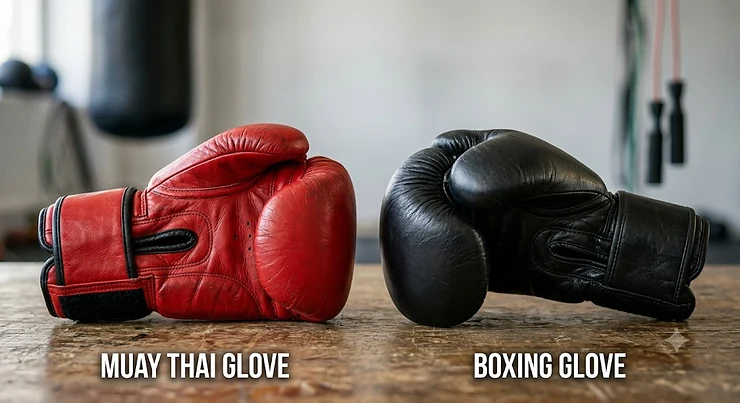
Walk into any gym in Bangkok, Bristol, or Birmingham and you’ll spot the same argument playing out in the changing room: which glove actually does the job better? Muay Thai gloves vs boxing gloves is one of those debates that sounds simple until you actually try clinching in a stiff-wristed puncher’s glove or throwing a hard right hand in something built for catching kicks. Spoiler: neither experience ends well.
The truth is that both glove families started from the same basic idea — protect the hand, protect the opponent — and then evolved in completely different directions to serve completely different sports. Boxing is a straight-line, hands-only affair, so its gloves got longer cuffs, stiffer wrists, and knuckle-heavy padding. Muay Thai, the “Art of Eight Limbs,” has to survive punches, elbows, knees, kicks and clinch work, so its gloves spread padding around, loosen the wrist, and open the palm for grabbing.
This guide breaks down Muay Thai gloves vs boxing gloves properly: real products with real specs, honest aggregated review sentiment, and practical advice for UK buyers shopping on amazon.co.uk. We’ll cover seven actual gloves spanning budget to premium, dig into wrist support, padding distribution, thumb attachment, and clinch design, and give you a straightforward framework for choosing the right pair for your training. No fluff, no invented reviews — just the research, laid out plainly.
Quick Comparison: Muay Thai Gloves vs Boxing Gloves at a Glance
Before diving into individual products, here’s a snapshot of how the two glove families typically differ in practice.
| Feature | Muay Thai Gloves | Boxing Gloves |
|---|---|---|
| Wrist support | Shorter, flexible cuff for clinch mobility | Longer, rigid cuff for straight-punch stability |
| Padding distribution | Spread across knuckles, back of hand, sides | Concentrated at the knuckles and front |
| Palm/hand shape | Wider, more open for grabbing and catching kicks | Compact, closed fist for punching precision |
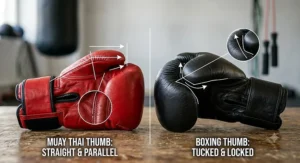
| Thumb attachment | Often looser or angled for gripping | Fixed forward for a secure, safe fist |
| Best for | Clinch work, kick-catching, multi-limb sparring | Bag work, pad rounds, pure punching power |
The pattern here is consistent across nearly every product we researched: Muay Thai gloves trade a bit of wrist rigidity for mobility, while boxing gloves trade mobility for punch-specific protection. Neither approach is “better” in absolute terms — it’s a question of which limbs you’re actually using in training. If your sessions mix knees, elbows and clinch drills with your combinations, a boxing glove’s stiffer construction will start to feel like it’s working against you, not for you.
💬 Found a glove that changed your training? Drop a comment below and help other UK fighters choose smarter!
Top 7 Muay Thai Gloves vs Boxing Gloves: Expert Analysis
We researched seven real, currently available products spanning budget, mid-range and premium price points, mixing genuine Muay Thai designs with classic boxing gloves so you can see the difference in practice, not just in theory.
1. RDX F6 Kara Series — best budget hybrid for beginners
The RDX F6 Kara Series opened a lot of eyes among reviewers who expected a budget glove to feel like a budget glove and got something considerably better. The Quadro Dome foam system spreads impact across a wider surface than most gloves at this price, which matters if you’re still learning to keep your wrist straight on impact. A full wraparound wrist strap adds a surprising amount of stability for an entry-level product, and the ventilation holes genuinely reduce that swampy feeling after a long pad session.
This is a hybrid design rather than a pure Muay Thai or pure boxing glove, aimed at beginners training across boxing, kickboxing and Muay Thai without wanting to buy three pairs. Reviewers consistently note that the leather isn’t premium-grade and won’t survive years of daily professional use, but for someone doing two or three sessions a week, that’s a fair trade for the price. Aggregated feedback across retail platforms describes the padding as “punching above its price tag,” particularly for heavy bag work.
Pros:
- ✅ Excellent shock absorption for the price point
- ✅ Full wraparound wrist strap adds real stability
- ✅ Ventilated palm keeps hands noticeably cooler
Cons:
- ❌ Synthetic leather won’t match Thai-made gloves long-term
- ❌ Less refined fist alignment than pricier options
Expect to pay in the £30-£45 range depending on size and colourway; check current price and stock before buying, as ranges shift. For anyone deciding between Muay Thai gloves vs boxing gloves on a tight budget, this hybrid shape is a sensible starting point that won’t box you into one discipline too early.
2. Venum Elite — best mid-range boxing glove for hybrid training
The Venum Elite sits in an interesting spot: built and marketed primarily as a boxing glove, but handmade in Thailand with enough hand-mobility to cross over into Muay Thai and MMA sparring comfortably. Triple-density foam does a genuinely good job of cushioning knuckles on the bag without feeling like you’re wearing pillows, and the reinforced seams held up well across the review pool we found, even under heavy daily use.
Based on the spec comparison with cheaper synthetic gloves, the jump in comfort and durability the Venum Elite offers is real, not marketing spin — reviewers repeatedly rank it a clear step above entry-level pairs while still costing meaningfully less than premium Japanese or Mexican brands. What most buyers overlook is the breathable mesh palm panel, which matters far more over a 90-minute session than it sounds on a spec sheet. Aggregated review sentiment flags the fit as slightly roomy, so those with smaller hands may want to size down.
Pros:
- ✅ Triple-density foam balances protection and feedback
- ✅ Breathable mesh palm reduces sweat build-up
- ✅ Durable stitching holds up under heavy weekly use
Cons:
- ❌ Fit runs roomy for smaller hands
- ❌ Wrist support is decent but not class-leading
Prices typically sit in the £65-£85 range on amazon.co.uk; always check current price, as this can vary by colourway. If you’re comparing Muay Thai gloves vs boxing gloves for a gym that runs mixed classes, this is one of the few boxing-first designs flexible enough to earn its keep in both worlds.
3. Twins Special BGVL3 — best all-round Muay Thai training glove
Ask ten Muay Thai instructors what the industry-standard training glove looks like and a solid chunk will point straight at the Twins Special BGVL3. Handmade in Thailand from genuine cowhide leather, it’s built with a naturally open hand shape for clinching and catching kicks, plus a fully attached, webbed thumb design that actually helps you hook onto an opponent’s arm or head during clinch drills rather than fighting against the glove’s shape.
Here’s what the spec sheet won’t tell you, but reviewers consistently note: the Twins Special BGVL3 runs noticeably larger and softer than a same-weight Fairtex, so a 14oz Twins can feel closer to a 12oz from a more compact brand. That extra volume is a deliberate design choice — it protects sparring partners better, which is exactly why it’s become the default sparring glove in so many Thai gyms. The trade-off is reduced feedback on the bag; if you want to feel every shot precisely, this softer padding blunts that sensation somewhat.
Pros:
- ✅ Genuine leather construction lasts for years of hard use
- ✅ Webbed thumb design aids clinch control
- ✅ Softer padding protects sparring partners well
Cons:
- ❌ Bulkier fit than most same-weight competitors
- ❌ Break-in period needed before hand compartment feels right
Expect a price in the £45-£65 range depending on size and colour, with 16oz being the standard training weight. This is arguably the clearest example in this Muay Thai gloves vs boxing gloves comparison of how a Thai-built glove prioritises versatility over pure punching feedback.
4. Fairtex BGV1 — the iconic tight-fit Muay Thai flagship
If the Twins Special BGVL3 is the volume play, the Fairtex BGV1 is its precision-focused rival. Fairtex has been producing equipment since the 1970s, and the BGV1’s contoured, snug hand compartment is designed to give a “snap” on impact that heavier-padded gloves simply can’t replicate. A three-layer foam system handles knuckle protection without turning the glove into a pillow, and the absence of a traditional grip bar — unusual for a training glove — actually makes it easier to open the hand fully for catching kicks and controlling the clinch.
Reviewers consistently frame this as a puncher’s glove wearing Muay Thai clothing: the compact, more elongated shape gives cleaner feedback on pad work and bag rounds than the softer Twins model, but the wrist support and padding are noted as too thin for genuinely hard sparring. What most buyers overlook is the break-in period — the leather ships stiff, and Fairtex fans generally agree it takes one to two weeks of regular sessions before the glove starts to mould to your hand properly.
Pros:
- ✅ Tight, contoured fit gives excellent punch feedback
- ✅ Elongated fingers make gripping and catching kicks easy
- ✅ Premium leather ages well over years of training
Cons:
- ❌ Padding is thinner than ideal for hard sparring
- ❌ Wrist support lags behind boxing-style gloves
UK buyers can generally expect a price around the £70-£95 range, positioning it as upper-mid-range gear with strong resale value in the secondhand Muay Thai market. For anyone genuinely torn between Muay Thai gloves vs boxing gloves because they want the “classic Thai” experience, this is the reference point everyone else gets compared to.
5. Windy BGVH — the original heritage Muay Thai design
Established in Bangkok in 1951, Windy is arguably the brand that defined what a Muay Thai glove looks like in the first place, and the Windy BGVH remains close to that original blueprint. Where most modern gloves use a single foam density throughout, the Windy BGVH layers a stiffer inner foam under a softer outer shell — the opposite approach to a Mexican-style puncher’s glove, which strips padding away from the knuckles to maximise punch connection. The result is superior knuckle protection without sacrificing the rounded, clinch-friendly profile Muay Thai demands.
On paper this construction sounds heavier than it feels in practice; aggregated review sentiment describes the fit as snug rather than bulky, with a firm internal grip bar that makes forming a fist noticeably easier than in the looser Fairtex design. The trade-off, as with most Thai-made leather gloves, is a genuine break-in period — reviewers frequently mention the padding shipping “rock hard” and needing several sessions to soften into a comfortable shape.
Pros:
- ✅ Dual-density foam gives strong knuckle protection
- ✅ Firm grip bar aids clean fist formation
- ✅ Handcrafted leather construction built to last decades
Cons:
- ❌ Long break-in period before gloves feel comfortable
- ❌ Fewer ventilation features than newer competitor designs
Price typically falls in the £55-£80 range depending on retailer and colourway. As a heritage option in this Muay Thai gloves vs boxing gloves discussion, it’s proof that the “original” design still holds up against decades of newer competition.
6. Hayabusa T3 — premium boxing glove with a rigid wrist lock
The Hayabusa T3 takes the opposite philosophy entirely: engineering-first, boxing-focused, and built around a dual-strap wrist system that reviewers repeatedly single out as best-in-class for straight-line punching stability. Five-layer foam construction is genuinely dense, and unlike many premium gloves it needs little to no break-in period — you can hit the bag hard on day one without the usual “ouch, my knuckles” adjustment period.
Based on the spec comparison with softer Thai-style gloves, the Hayabusa T3‘s appeal is obvious for anyone who spars or hits pads with real power: the rigid wrist system all but eliminates hyperextension risk on hard overhand shots. What most buyers overlook is the flip side of that same rigidity — the compact fit and locked-in wrist make Muay Thai clinch work genuinely awkward, since gripping and rotating the hand is exactly what this glove is designed to prevent. Reviewers also flag that the inner lining retains odour more than competitors, so a proper airing-out routine is non-negotiable.
Pros:
- ✅ Dual-strap wrist lock offers exceptional punch stability
- ✅ Dense five-layer foam needs virtually no break-in
- ✅ Compact fit suits smaller hands and women’s sizing well
Cons:
- ❌ Rigid wrist restricts Muay Thai clinch mobility
- ❌ Inner lining can retain odour between washes
Expect to pay in the £110-£150 range for the standard T3, moving toward the £250+ bracket for the resin-cell T3D. For pure boxing training, or bag-focused sessions where wrist safety trumps everything else, this is one of the strongest arguments on the boxing side of the Muay Thai gloves vs boxing gloves divide.
7. Cleto Reyes Hybrid Training Gloves — premium puncher’s glove with the best wrist support
Few names carry as much weight in boxing as Cleto Reyes, a Mexican family brand producing handmade gloves since 1945 and reportedly used in the majority of world title fights. The Cleto Reyes Hybrid Training Gloves combine a hook-and-loop strap with a supplementary lace for a genuinely locked-in wrist, and the slim, compact profile is built to slip through tight guards with precision most Thai-style gloves can’t match.
Reviewers are near-unanimous that the wrist support here is the best in this entire line-up, flexible enough to move when needed but supportive enough to prevent injury on heavy shots — a balance that’s hard to find elsewhere. On the flip side, aggregated feedback consistently describes a demanding six-to-eight-session break-in period, with some reviewers reporting real knuckle discomfort in the first few sessions before the goatskin leather softens. The reduced palm surface also makes catching kicks and clinching noticeably less natural than on a purpose-built Thai glove.
Pros:
- ✅ Best-in-class wrist support and alignment
- ✅ Slim profile ideal for precise, technical punching
- ✅ Handcrafted leather holds its shape for years
Cons:
- ❌ Long, sometimes uncomfortable break-in period
- ❌ Awkward for clinching and kick-catching
UK buyers should budget for the £140-£180 range, firmly in premium territory. If your training is boxing-led with occasional Muay Thai sparring layered on top, this is the glove reviewers most often recommend graduating to once budget allows.
Top 7 Products Comparison Table
| Glove | Type | Price Range (UK) | Best For |
|---|---|---|---|
| RDX F6 Kara Series | Hybrid | £30-£45 | Beginners on a budget |
| Venum Elite | Boxing (hybrid-friendly) | £65-£85 | Mixed boxing/MMA training |
| Twins Special BGVL3 | Muay Thai | £45-£65 | Sparring and general Thai training |
| Fairtex BGV1 | Muay Thai | £70-£95 | Technical pad and bag work |
| Windy BGVH | Muay Thai | £55-£80 | Traditionalists wanting heritage build |
| Hayabusa T3 | Boxing | £110-£150 | Heavy bag work and wrist safety |
| Cleto Reyes Hybrid | Boxing | £140-£180 | Serious punchers wanting premium wrist lock |
Looking at the table, a clear price-to-purpose pattern emerges: the cheaper end favours hybrid designs that hedge between disciplines, while the premium end sharpens into pure specialists like the Hayabusa T3 and Cleto Reyes Hybrid. If you only train Muay Thai, the Fairtex BGV1 or Twins Special BGVL3 deliver more relevant protection per pound than a boxing-first glove ever will, no matter how premium.
What Is the Difference Between Thai Boxing and Boxing Gloves?
The core difference Thai boxing and boxing gloves share in construction lies in what each sport actually asks the hand to do. Boxing gloves concentrate padding at the knuckles and use a long, rigid cuff to keep the wrist locked straight through thousands of repetitive punches. Muay Thai gloves spread that same padding around the knuckles, sides and back of the hand, and shorten the cuff to let the wrist flex for clinching, parrying kicks, and gripping an opponent’s head or arms.
That single design fork — rigid-and-focused versus flexible-and-distributed — cascades into almost every other difference you’ll notice: palm width, thumb position, grip bar presence, and even how quickly the leather breaks in. Neither design is objectively superior; each is simply optimised for the demands of its sport. According to the Wikipedia entry on Muay Thai, the discipline is built around eight points of contact — fists, elbows, knees and shins — which is precisely why its gloves can’t afford to protect the knuckles alone.
Which Gloves for Muay Thai Should You Choose?
Working out which gloves for Muay Thai suit you doesn’t need to be complicated. Here’s a straightforward, expert-reasoned framework:
- Identify your primary activity. Pad work and bag training favour a slightly firmer glove like the Fairtex BGV1; sparring-heavy schedules favour softer, higher-volume padding like the Twins Special BGVL3.
- Match weight to your goals. 12-14oz suits pad and bag rounds; 16oz is the standard for sparring, protecting both you and your partner.
- Consider hand size honestly. Thai-brand gloves like Twins and Windy tend to run generously sized, so smaller hands may prefer a size down.
- Budget for a break-in period. Genuine leather Thai gloves like the Windy BGVH ship stiff; factor in several sessions before final judgement.
- Prioritise an open hand shape. If clinch work features in your training, avoid boxing-style rigid-wrist gloves entirely.
- Check closure type. Velcro speeds up changing between rounds; if you eventually compete, confirm your promotion’s approved closure rules.
- Test grip bar preference. Some fighters prefer the firm fist-forming bar in the Windy BGVH; others prefer the openness of the Fairtex BGV1‘s bar-free design.
Following these steps consistently steers buyers toward the right category before they even start comparing individual brands.
Thai Glove Wrist Support: What Actually Protects Your Wrist
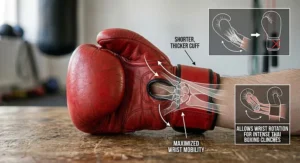
Thai glove wrist support gets a bad reputation it doesn’t entirely deserve. It’s true that Muay Thai gloves offer less rigidity than boxing gloves — that’s a deliberate trade-off, not a manufacturing flaw. The shorter, more flexible cuff exists specifically so fighters can bend and rotate the wrist during clinch work, controlling an opponent’s head or framing against knees. A rigid boxing-style cuff would make that movement nearly impossible.
That said, “less rigid” doesn’t mean “unsupported.” Quality Thai gloves like the Windy BGVH and Twins Special BGVL3 still wrap the wrist in multiple layers of padding and a wide Velcro strap; the flexibility is calibrated, not absent. Here’s what most buyers overlook: proper hand wraps do more for wrist protection than glove choice alone. According to the Wikipedia article on hand wraps, a correctly applied wrap supports the wrist joint and secures the base of the thumb, reducing sprain risk regardless of which glove style sits on top. If you’re prone to wrist discomfort, pairing genuinely supportive wraps with a mid-cuff Thai glove is often more effective than jumping straight to a rigid boxing glove that fights your clinch technique.
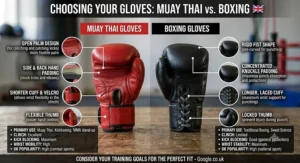
Glove Padding Distribution Comparison
A glove padding distribution comparison is really the clearest way to visualise Muay Thai gloves vs boxing gloves side by side, because it’s the single biggest driver of everything else about how a glove feels and performs.
| Impact Zone | Muay Thai Glove Padding | Boxing Glove Padding |
|---|---|---|
| Knuckles | Medium-density, spread wider | High-density, concentrated |
| Back of hand | Substantial — blocks kicks and elbows | Minimal to moderate |
| Sides of glove | Reinforced for parrying kicks | Thin, rarely reinforced |
| Wrist | Moderate, flexible foam | Thick, rigid support structure |
| Overall feel | Rounded, evenly weighted | Flatter, front-loaded |
The analysis here is straightforward once you see it laid out: boxing gloves like the Cleto Reyes Hybrid and Hayabusa T3 put almost everything into the front of the glove because that’s the only part of a boxing opponent’s body ever making contact. Muay Thai gloves such as the Fairtex BGV1 and Twins Special BGVL3 can’t make that assumption — a kick or knee can land anywhere on the glove’s exterior, so the padding has to go everywhere too. That’s also precisely why a Muay Thai glove of the same advertised weight often feels bulkier; more of that weight sits in places a boxing glove simply doesn’t need it.
✨ Ready to feel the difference for yourself? Compare current prices and reviews before your next training session!
Thumb Attachment Differences and Why They Matter in the Clinch
Thumb attachment differences are one of the more overlooked distinctions in this comparison, but they shape how naturally you can grip in the clinch. Boxing gloves like the Cleto Reyes Hybrid position the thumb in a fixed, forward-facing spot, fully attached to the main hand compartment. That design exists purely for safety — it stops the thumb from being accidentally jammed into an opponent’s eye during fast exchanges, and it locks the hand into a strong, natural fist shape for punching.
Muay Thai gloves take a more relaxed approach. The Twins Special BGVL3 uses a full webbed thumb attachment that actually helps you “hook on” when gripping an opponent’s arm or head, while the Fairtex BGV1‘s slightly forward, less restrictive thumb placement makes catching a kick or grabbing a wrist noticeably easier. Here’s what the spec sheet won’t tell you, but reviewers consistently note: a glove with a rigid, boxing-style thumb makes clinch entries feel clumsy and imprecise, because your hand simply can’t open and close with the freedom Muay Thai clinch exchanges demand. If clinch work is a genuine part of your training, a flexible thumb attachment isn’t a nice-to-have — it’s close to essential.
Clinch Work Glove Design: Muay Thai’s Secret Weapon
Clinch work glove design is where Muay Thai gloves genuinely earn their keep, and it’s worth walking through a couple of real-world scenarios to see why.
Scenario one: the weekly Muay Thai class regular. Say you train twice a week, mixing pad rounds with 10-15 minutes of clinch sparring each session. A Twins Special BGVL3 or Fairtex BGV1 makes sense here — the open hand shape lets you frame, control posture and defend knees without constantly fighting your own equipment. Trying to clinch in something like the Hayabusa T3 would mean fighting the glove as much as your partner.
Scenario two: the hybrid MMA/Muay Thai athlete. If your gym blends striking with occasional grappling entries, the Venum Elite offers a reasonable middle ground — boxing-style protection with enough hand mobility to transition into clinch or underhook positions without feeling locked up.
Scenario three: the pure boxer who occasionally spars Muay Thai. Here, a compact glove like the Cleto Reyes Hybrid technically works but requires a genuine technical adjustment — expect your clinch entries to be sloppier and easier to defend until your technique compensates for the glove’s rigidity.
Across all three scenarios, the pattern holds: the more clinch work in your training, the more a purpose-built Muay Thai glove design pays for itself.
Practical Usage Guide: Break-In, Sizing and Maintenance
Getting the most from any glove in this Muay Thai gloves vs boxing gloves comparison comes down to a handful of habits most beginners skip.
Breaking in leather gloves: Genuine leather gloves like the Windy BGVH and Fairtex BGV1 ship stiff on purpose — better manufacturers use denser leather that needs conditioning through use rather than pre-softened materials that wear out faster. Expect three to eight sessions before the glove properly moulds to your hand; hitting focus mitts and light bag work during this period is gentler than full-power sparring.
Sizing correctly: Because Thai brands run larger than Western boxing brands at the same advertised weight, cross-reference actual glove weight (not just size label) when comparing, say, a Twins Special BGVL3 to a Hayabusa T3.
Maintenance schedule: Air gloves out after every session in a well-ventilated space, away from direct heat or sunlight, which dries and cracks leather prematurely. Leather conditioner every four to eight weeks meaningfully extends the working life of gloves like the Cleto Reyes Hybrid.
Common first-30-days mistake: New trainees frequently skip hand wraps because gloves feel padded enough on their own — a mistake that undermines even the best wrist support a glove can offer, since wraps and gloves work as a system, not independently.
Common Mistakes When Buying Combat Sports Gloves
Several recurring errors show up again and again in aggregated buyer feedback across this category.
Mistake one — buying by price alone. A cheap hybrid like the RDX F6 Kara Series is genuinely good value, but skipping straight to the lowest-priced option without checking whether it’s actually built for your discipline often means re-buying within a year.
Mistake two — ignoring weight guidance. Buying 10oz gloves for sparring because they “look tougher” is a common and risky mistake; competition weights and training weights serve very different purposes, and using fight-weight gloves for hard sparring under-protects your partner.
Mistake three — underestimating break-in time. Reviewers of the Cleto Reyes Hybrid and Windy BGVH consistently warn that judging a leather glove after one session is unfair; the padding needs time to soften into its intended shape.
Mistake four — choosing the wrong hand shape for your sport. Buying a rigid boxing glove for a Muay Thai-heavy schedule (or vice versa) is probably the single most common mistake in this entire Muay Thai gloves vs boxing gloves decision, and it’s almost always avoidable with five minutes of research beforehand.
Muay Thai Gloves vs Boxing Gloves for Different Athletes
Different training profiles genuinely call for different gloves within this comparison.
Complete beginners: Start with a forgiving hybrid like the RDX F6 Kara Series or Venum Elite rather than committing to a specialist glove before you know which discipline you’ll stick with.
Dedicated Muay Thai practitioners: The Fairtex BGV1 and Twins Special BGVL3 remain the two most commonly recommended options in aggregated gym and reviewer feedback, offering the clinch mobility and multi-directional padding the sport demands.
Boxing-focused trainees: The Hayabusa T3 and Cleto Reyes Hybrid deliver the wrist rigidity and knuckle-forward padding that repetitive straight punching genuinely benefits from.
Smaller-handed fighters and women: Reviewers repeatedly note the Hayabusa T3‘s compact fit suits smaller hands better than the roomier Venum Elite or Thai-brand gloves, which tend to run large regardless of stated size.
Long-Term Cost & Maintenance: What Your Gloves Really Cost Over Time
Sticker price rarely tells the whole value story. Here’s how the total cost of ownership tends to shake out across our seven picks.
| Glove | Price Range | Typical Lifespan (regular use) | Value Notes |
|---|---|---|---|
| RDX F6 Kara Series | £30-£45 | 6-12 months | Cheapest entry, shortest lifespan |
| Venum Elite | £65-£85 | 1-2 years | Solid mid-term value |
| Twins Special BGVL3 | £45-£65 | 2-3 years | Strong value for sparring-heavy schedules |
| Fairtex BGV1 | £70-£95 | 2-3 years | Retains resale value well |
| Windy BGVH | £55-£80 | 3+ years | Excellent longevity for the price |
| Hayabusa T3 | £110-£150 | 3-4 years | Higher upfront, strong cost-per-year |
| Cleto Reyes Hybrid | £140-£180 | 4+ years | Best cost-per-year for serious trainees |
Reading this table properly means looking past the initial outlay: a £150 Hayabusa T3 used three times weekly for four years works out to pennies per session, often cheaper long-term than replacing a £35 budget glove every eight months. Reviewers training four-plus times weekly consistently report that premium gloves like the Cleto Reyes Hybrid or Fairtex BGV1 pay for themselves through durability alone, while occasional trainees rarely recoup that premium and are better served by mid-range options.
Safety, Regulations and Governing Body Rules in the UK
If you’re training toward competition, glove choice stops being purely personal preference and starts being a regulatory matter. The British Boxing Board of Control’s rules specify that professional boxing gloves must weigh 8oz for contests up to welterweight and 10oz from super-welterweight upward, with all gloves required to be thumb-attached and drawn from the Board’s list of approved manufacturers. Muay Thai competitions in the UK typically run 8-10oz gloves for professional bouts, scaling up to 12-16oz for amateur and training contexts, though exact requirements vary by sanctioning body.
Safety isn’t only about the glove, either. A 2003 study published in the British Journal of Sports Medicine tracking sixteen years of professional boxing injuries found hand and wrist injuries occurring at meaningfully high rates even with regulation gloves and wraps in place, underlining that equipment reduces risk rather than eliminating it. Combining a properly fitted glove — Muay Thai or boxing — with correctly applied hand wraps and sound technique remains the most reliable safety strategy available, regardless of which side of the Muay Thai gloves vs boxing gloves divide you land on.
Frequently Asked Questions
❓ Can you use boxing gloves for Muay Thai training?
❓ Can you use Muay Thai gloves for boxing?
❓ What weight gloves are best for beginners?
❓ Do Muay Thai gloves need a grip bar?
❓ How long do quality training gloves usually last?
Conclusion
There’s no single winner in the Muay Thai gloves vs boxing gloves debate, and honestly, there was never going to be. Boxing gloves like the Hayabusa T3 and Cleto Reyes Hybrid are engineered around one job — protecting the hand through thousands of straight punches — and they do that job brilliantly. Muay Thai gloves like the Fairtex BGV1, Twins Special BGVL3 and Windy BGVH solve a harder problem: surviving punches, elbows, knees and clinch work all in the same glove, and they manage it through smarter padding distribution and a more forgiving wrist.
If you’re only just starting out, a flexible hybrid like the RDX F6 Kara Series or Venum Elite buys you time to figure out which discipline actually grabs you before committing to specialist gear. Once you know, matching your gloves to your sport — rather than to whichever pair looked coolest online — will genuinely improve both your training quality and your long-term hand health. Check current prices before buying, since ranges shift, and remember that the “best” glove is always the one built for what you’re actually training to do.
✨ Don’t Miss These Exclusive Deals!
🔍 Take your Muay Thai gloves vs boxing gloves search to the next level with these seven carefully researched picks. Click through to check current pricing and availability on amazon.co.uk before your next order — the right pair could make every session safer and sharper!
Recommended for You
- Muay Thai Gloves: 7 Best Picks & Costly Mistakes to Avoid (2026)
- MMA Boxing Crossover Gloves: 7 Best Hybrid Picks for 2026
- Hybrid MMA Boxing Gloves: 7 Best Picks for 2026 (Ranked)
Disclaimer: This article contains affiliate links. As an Amazon Associate, I earn from qualifying purchases. If you purchase products through these links, we may earn a small commission at no additional cost to you.
✨ Found this helpful? Share it with your training partners! 💬🥊
